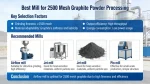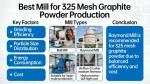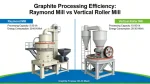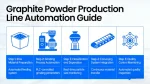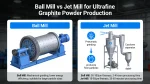
For ultrafine graphite powder production, jet mills are generally preferred for battery-grade and high-purity applications requiring narrow PSD, spherical morphology, and submicron fineness (D50 < 5 μm). Ball mills remain cost-effective for larger-scale production of coarser ultrafine graphite (D50 5–20 μm) where spherical shape and ultra-high purity are less critical.
Core Working Principles
| Technology | Working Mechanism | Key Features |
|---|---|---|
| Ball Mill | Rotating cylinder with grinding media (steel/ceramic balls) that impact and shear particles | Mechanical contact-based comminution; can be wet or dry; low-speed operation (typically <500 RPM) |
| Jet Mill | High-pressure gas (air/nitrogen) accelerates particles to supersonic speeds, causing particle-on-particle collision in a grinding chamber | Autogenous (particle-on-particle) grinding; no moving parts in grinding zone; dry process only |
Performance Comparison for Graphite Processing
1. Particle Size Capability
| Parameter | Ball Mill | Jet Mill | Significance |
|---|---|---|---|
| Typical D50 | 5–200 μm; ultrafine down to ~5 μm with special liners/media | 0.2–10 μm; submicron achievable (0.2–1 μm) | Jet mills excel for submicron applications (e.g., advanced battery materials) |
| Maximum Fineness | Limited to ~1 μm with extreme processing (long time, small media) | Down to 0.1 μm for specialized designs | Jet mills handle true nanoscale requirements |
| Size Reduction Efficiency | Poor for graphite—flaky particles tend to adhere to balls/jar surfaces instead of breaking (ball diameter increased by 20%+ in tests) | Excellent for graphite—71% average particle size reduction in tests | Jet mills overcome graphite’s lubricity and flakiness issues |
2. Particle Size Distribution (PSD) & Morphology
| Aspect | Ball Mill | Jet Mill | Impact on Graphite Performance |
|---|---|---|---|
| PSD Width | Broad (high D90/D10 ratio) | Narrow (tight D90/D10 control) | Narrow PSD critical for consistent battery anode performance |
| Particle Shape | Maintains flaky, irregular morphology; minimal spheroidization | Enables spheroidization—transforms flaky graphite into smooth, spherical particles | Spherical shape improves tap density (up to 963 g/L), packing efficiency, and cycle life in Li-ion batteries |
| Surface Quality | Irregular surfaces with micro-cracks from mechanical impact | Smooth surfaces with minimal defects due to particle-on-particle collision | Smoother surfaces reduce SEI formation issues and irreversible capacity loss in batteries |
3. Purity & Contamination Control
| Contamination Factor | Ball Mill | Jet Mill | Critical for Battery Applications |
|---|---|---|---|
| Grinding Media Wear | High—media (steel/ceramic) inevitably contaminates product; requires high-purity ceramic media (alumina/zirconia) to minimize metal impurities | Minimal—no mechanical media; autogenous grinding (particle-on-particle) with optional ceramic linings | Metal contamination degrades battery performance and safety; jet mills provide “cleaner” grinding |
| Cross-Contamination | Higher risk—residues adhere to internal surfaces; requires thorough cleaning | Lower risk—simpler internal geometry; easier to purge between batches | Critical for multi-product facilities |
| Airborne Impurities | Low—closed system (if properly sealed) | Medium—depends on air quality; requires high-grade filtration/drying systems | Controllable with proper air treatment |
4. Energy Efficiency & Cost Analysis
| Cost Aspect | Ball Mill | Jet Mill | Implications for Production |
|---|---|---|---|
| Capital Cost (CAPEX) | Lower—simpler design, fewer components | Higher—complex gas compression, classification systems | Ball mills better for budget-constrained operations |
| Energy Consumption | Lower for coarser ultrafine (5–20 μm); increases exponentially for submicron sizes | Higher overall (30–100 kWh/t vs 15–50 kWh/t for ball mills); but more efficient for submicron grinding | Jet mills costlier to operate but provide better energy-to-fineness ratio for D50 < 5 μm |
| Operating Cost (OPEX) | Lower—minimal wear parts beyond media replacement | Higher—compressed air costs dominate; requires regular filter maintenance | Ball mills more economical for high-volume production of less critical grades |
| Maintenance | Moderate—media replacement, liner wear, bearing checks | Low—no media; only gas nozzles, filters, and classifier require attention | Jet mills offer longer uptime despite higher initial investment |
5. Throughput & Scalability
| Parameter | Ball Mill | Jet Mill | Production Planning Considerations |
|---|---|---|---|
| Typical Throughput | Higher—handles large volumes (1–100 t/h) for medium fineness | Lower—typically 0.1–10 t/h for submicron grinding; scales with multiple units | Ball mills better for mine-mouth or large-scale operations |
| Feed Size Requirement | Coarse feed acceptable (up to 50 mm) | Requires fine pre-grinding (typically <1 mm) for efficient submicron production | Jet mill lines need additional pre-processing steps |
| Scalability | Excellent—single unit capacity increases with size; modular design possible | Good—parallel installation of multiple mills; easier to scale incrementally | Jet mills offer flexibility for capacity expansion |
6. Special Considerations for Graphite
| Aspect | Ball Mill | Jet Mill | Graphite-Specific Impact |
|---|---|---|---|
| Graphite Lubricity | Negative—particles adhere to surfaces; reduces grinding efficiency; requires surfactants/dispersants for effective processing | Positive—particle-on-particle collision overcomes lubricity issues; efficient comminution without additives | Jet mills avoid “ball coating” phenomenon common with ball mills for graphite |
| Thermal Control | Risk of heat buildup (especially with long cycles); requires cooling systems for heat-sensitive materials | Adiabatic cooling effect from gas expansion helps control temperature; but compression generates heat | Graphite oxidation risk minimized with jet mills at ≤80°C operation |
| Crystal Structure Impact | Can damage graphite’s layered structure with excessive mechanical stress | More gentle particle fracture preserves crystalline integrity better | Critical for maintaining battery performance (electrical conductivity, Li intercalation) |
Application Suitability Matrix
| Graphite Application | Preferred Mill | Rationale |
|---|---|---|
| Lithium-Ion Battery Anodes | Jet Mill | Narrow PSD, spherical shape, high purity, submicron fineness (D50 5–10 μm) critical for energy density and cycle life |
| Conductive Fillers | Either—Ball Mill for cost; Jet Mill for high-performance | Ball mills sufficient for general applications; jet mills better for demanding electronic uses |
| Lubricants | Either—Ball Mill for standard grades; Jet Mill for premium | Flaky graphite acceptable for many lubricant applications |
| Refractories | Ball Mill | Coarser ultrafine (D97 45–75 μm) sufficient; cost-effectiveness prioritized |
| Carbon Blocks | Ball Mill | High throughput and moderate fineness requirements; additives improve packing density |
| Advanced Composites | Jet Mill | Submicron size and narrow PSD enhance composite properties |
Key Decision Factors for Ultrafine Graphite Production
- Fineness Requirement: Choose jet mill if D50 < 5 μm or submicron sizes needed; ball mill for D50 5–20 μm
- Morphology Needs: Jet mill for spherical graphite (battery anodes); ball mill for flaky graphite applications
- Purity Standards: Jet mill for battery-grade (≤100 ppm impurities); ball mill acceptable for industrial grades with proper media selection
- Production Scale: Ball mill for >10 t/h throughput; jet mill for smaller capacities or when quality outweighs volume
- Budget Constraints: Ball mill for limited CAPEX; jet mill justifiable for high-value applications despite higher costs
Implementation Recommendations
- Battery Anode Production: Implement a two-stage process—ball mill for initial size reduction (to ~100 μm), followed by jet mill for ultrafine grinding and spheroidization
- Cost-Effective Ultrafine Graphite: Use ceramic-lined ball mills with high-purity media for D50 5–10 μm production; avoid excessive processing time to prevent structure damage
- Submicron Graphite: Jet mill with integrated classifier for precise PSD control and maximum yield of target particle sizes
Jet mills dominate for premium ultrafine graphite applications where spherical morphology, narrow PSD, and ultra-high purity are non-negotiable (e.g., EV battery anodes). Ball mills remain the workhorse for cost-sensitive, large-scale production of coarser ultrafine graphite where these properties are secondary. For many manufacturers, the optimal solution combines both technologies in a complementary processing line to balance cost, quality, and production efficiency.