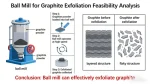
can ball mill be used for graphite exfoliation

ball milling is a well-established and widely used method for the exfoliation of graphite to produce graphene (or few-layer graphene). It is considered one of the most promising techniques for the large-scale, cost-effective, and environmentally friendly production of graphene. How Ball Milling Exfoliates Graphite The process typically involves: Mechanical Shear and Impact: Graphite powder is placed in a ball mill (often a planetary ball mill for higher energy) along with grinding media (balls made of steel, zirconia, agate, etc.) and a liquid medium (solvent) or sometimes specific solid additives. Exfoliation Mechanism: As the…

ball milling is a well-established and widely used method for the exfoliation of graphite to produce graphene (or few-layer graphene). It is considered one of the most promising techniques for the large-scale, cost-effective, and environmentally friendly production of graphene.

How Ball Milling Exfoliates Graphite

The process typically involves:
  1. Mechanical Shear and Impact: Graphite powder is placed in a ball mill (often a planetary ball mill for higher energy) along with grinding media (balls made of steel, zirconia, agate, etc.) and a liquid medium (solvent) or sometimes specific solid additives.
  2. Exfoliation Mechanism: As the mill rotates at high speeds, the balls collide with the graphite particles and each other. This generates intense shear forcesimpact forces, and compression forces. These forces overcome the weak van der Waals forces holding the graphene layers together in bulk graphite, causing them to separate (exfoliate) into thinner sheets.
  3. Role of Medium/Additives:
    • Liquid Phase Exfoliation (LPE): Using a suitable solvent (e.g., N-methyl-2-pyrrolidone (NMP), dimethylformamide (DMF), water with surfactants, or even organic solvents like 2-ethylhexanol or kerosene as found in recent studies) helps stabilize the exfoliated graphene sheets, preventing them from re-aggregating. The solvent can also aid in transferring shear stress more effectively.
    • Solid Additives: Sometimes, small molecules (like melamine, urea, or naphthalene derivatives) or salts are added. These can intercalate between graphite layers or act as “wedges” during milling, facilitating exfoliation and potentially reducing defect formation compared to dry milling alone. Recent research (e.g., Padi et al., 2024) highlights “naphthalene-assisted ball-mill exfoliation” for high yields.

Advantages of Ball Milling for Graphite Exfoliation

  • Scalability: Easily scalable from laboratory (grams) to industrial (kilograms/tons) production.
  • Cost-Effectiveness: Relatively low equipment and operational costs compared to methods like Chemical Vapor Deposition (CVD).
  • Simplicity: The process is straightforward and doesn’t always require complex chemical reactions or harsh conditions (though solvents/additives are often used).
  • Versatility: Can be adapted for dry or wet milling, with various solvents and additives to optimize yield and quality.
  • Direct Production: Can produce graphene dispersions directly usable in composites, inks, or coatings.

Challenges and Considerations

  • Defect Formation: High-energy impacts can introduce defects (vacancies, Stone-Wales defects, edge damage) into the graphene lattice, potentially affecting its electrical and mechanical properties. Optimizing milling parameters (time, speed, ball-to-powder ratio, ball size) is crucial to minimize defects.
  • Layer Control: Achieving a uniform number of layers (especially single-layer graphene) can be challenging; the product is often a mixture of few-layer graphene sheets.
  • Contamination: Wear from the milling balls and jar can introduce impurities (e.g., Fe, Zr, Al) into the final product. Choosing appropriate milling media (e.g., zirconia, agate) is important.
  • Processing Time: Long milling times (often several hours to tens of hours) may be required for effective exfoliation, which can increase energy consumption and potential defect accumulation.
  • Solvent Removal: If liquid phase exfoliation is used, removing the solvent without causing re-aggregation can be an additional step.
About Us:
With over 20 years of dedicated expertise in ultrafine grinding technology, we deliver high-performance machinery that matches the precision and reliability of leading German and Japanese brands—at only 1/3 of their cost.

Beyond Equipment, We Deliver Total Confidence:
We provide Free Material Testing to ensure precise equipment selection, followed by professional on-site installation and comprehensive training. Our 24/7 technical support team ensures your production line remains efficient and worry-free.

Schedule Material Trial & Get a Customized Solution from Us

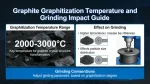
Graphitization is the high-temperature transformation of amorphous carbon into ordered graphite structure with hexagonal layers held by weak Van der Waals forces. The temperature requirements vary by application and material:…

15/03/2026

Expandable graphite (EG) is produced by inserting non-carbon atoms/molecules between flake graphite layers via grinding activation and chemical/electrochemical intercalation, creating graphite intercalation compounds (GICs) that expand dramatically when heated. Below…

14/03/2026

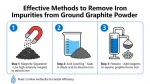
The most effective iron removal from ground graphite powder typically uses a multi-stage approach combining magnetic separation (for ferromagnetic particles) and chemical leaching (for oxidized and chemically bound iron), followed…

13/03/2026

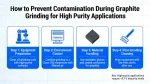
For high-purity graphite grinding (e.g., lithium-ion battery anode graphite with strict impurity requirements), contamination prevention needs a full-process control strategy covering equipment design/materials, grinding process, environmental management, material handling, and…

12/03/2026

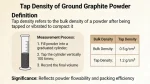
The tap density of ground graphite powder typically ranges from 0.10 g/cm³ to 1.30 g/cm³, with most common industrial values falling between 0.80 g/cm³ and 1.20 g/cm³ for battery-grade graphite…

10/03/2026

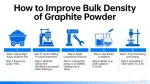
Bulk density = loose packing density (before tapping). Higher bulk density = better flow, less dust, less bridging, easier transportation. 1. Optimize Particle Size Distribution (Most Effective) Use wide particle…

09/03/2026

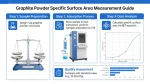
To measure the specific surface area (SSA) of graphite powder for quality assessment, the BET (Brunauer-Emmett-Teller) gas adsorption method is the industry standard (ISO 9277:2022, ASTM D8325-20) ASTM. It provides…

08/03/2026

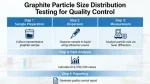
Quality control for graphite particle size requires representative sampling, proper dispersion to avoid agglomeration, and method matching to particle size range (sieving for >38 μm, laser diffraction for 0.1–1000 μm,…

07/03/2026

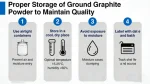
To maintain the quality of ground graphite powder, focus on controlling moisture, preventing oxidation, avoiding contamination, and managing physical degradation (agglomeration, particle size changes). Below is a structured approach to…

06/03/2026

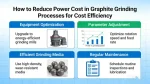
To reduce power costs in graphite grinding for cost efficiency, focus on equipment upgrades (20-60% savings), process optimization (15-30% savings), media selection (10-44% savings), automation (10-20% savings), and energy management…

05/03/2026