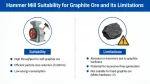
Hammer mills are suitable for graphite ore in coarse-to-medium crushing stages (0-3mm output) , especially for amorphous graphite or pre-processing crystalline graphite before beneficiation. However, they have critical limitations for fine grinding and flake graphite preservation , making them inappropriate for high-value applications requiring intact flake structure or ultra-fine particle sizes.
✅ Suitability for Graphite Ore
1. Working Principle Compatibility
Hammer mills operate via high-speed impact crushing (rotor speeds up to 3,600 RPM) , ideal for graphite’s properties:
- Mohs hardness 1-2: Extremely soft, well within hammer mill’s operational range (1-5 Mohs)
- Brittleness: Graphite shatters easily under impact without significant deformation
- Lubricity: Reduces internal friction, minimizing heat buildup compared to other materials
2. Processing Applications
| Application | Suitability | Rationale |
|---|---|---|
| Primary/Secondary Crushing | ★★★★★ | Efficiently reduces run-of-mine ore (up to 50mm) to 0-3mm |
| Amorphous Graphite Processing | ★★★★☆ | Less concerned with flake preservation; high throughput (8-70t/h) |
| Pre-Beneficiation Preparation | ★★★★☆ | Creates uniform particle size for flotation/leaching |
| Graphite Scrap Recycling | ★★★★☆ | Effective for breaking down graphite electrodes and waste |
| Coarse Powder Production | ★★★★☆ | D90 typically 0-3mm; suitable for non-critical industrial uses |
3. Key Advantages for Graphite Processing
- High crushing ratio: Single-stage reduction from 50mm to sub-3mm
- Low capital cost: Simple construction compared to ball mills or jet mills
- Easy maintenance: Fewer complex components than stirred mills
- Dry processing capability: Avoids water contamination for certain graphite applications
- Scalability: Range from small lab units to large industrial machines (12-650t/h)
⚠️ Limitations for Graphite Ore
1. Flake Graphite Damage (Critical Limitation)
- Severe flake destruction: High-velocity impacts shatter graphite’s layered structure, reducing flake size and aspect ratio
- Value degradation: Flake size directly correlates with market price; hammer milling destroys large flakes (100+ mesh)
- Non-selective breakage: Fractures occur across grain boundaries rather than along natural cleavage planes
- Unsuitable for battery-grade graphite: Lithium-ion applications require intact flake structures for optimal performance
2. Particle Size Limitations
- Fine grinding ceiling: Standard hammer mills struggle to produce particles below 45μm D90
- Screen dependency: Output size controlled by screen openings (minimum practical ~0.2mm)
- Poor particle size distribution: Wide range of particle sizes; less uniform than ball/rod mills
- Unsuitable for ultra-fine applications: Cannot achieve sub-10μm sizes required for advanced materials
3. Equipment Wear and Maintenance Issues
- Rapid hammer/screen wear: Graphite’s mineral impurities (quartz, feldspar) act as abrasives
- Increased downtime: Frequent hammer replacement (every 200-500 hours for mineral processing)
- Graphite dust challenges: Requires specialized dust collection systems
- Screen clogging: Graphite fines can adhere to screens, reducing throughput
4. Performance Limitations with Specific Graphite Types
| Graphite Type | Limitation Severity | Technical Reason |
|---|---|---|
| Crystalline Flake Graphite | ★★★★★ | Destroys valuable flake structure; reduces recovery rates |
| High-Purity Graphite | ★★★☆☆ | Risk of iron contamination from hammer wear |
| Moist Graphite Ore | ★★★☆☆ | Causes screen blinding and reduced capacity |
| Graphite with Clay Content | ★★★☆☆ | Increased stickiness leads to operational issues |
5. Energy Efficiency and Heat Generation
- Lower efficiency for fine grinding: Energy consumption increases exponentially below 100μm
- Heat buildup: Friction from high-speed impacts can alter graphite’s physical properties
- Not suitable for temperature-sensitive applications: Risk of surface oxidation at elevated temperatures
🧭 Application Guidelines: When to Use/Not Use Hammer Mills for Graphite
Recommended Uses
- Amorphous graphite processing where flake structure is irrelevant
- Initial ore reduction before rod/ball mill fine grinding
- Graphite waste/scrap recycling
- Low-cost, high-throughput operations for industrial-grade graphite (not battery or high-purity applications)
Not Recommended Uses
- Any application requiring flake preservation (especially battery anode materials)
- Fine grinding below 45μm (use jet mills, stirred mills, or ball mills instead)
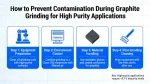
- High-purity graphite production (risk of contamination)
- Processing of high-moisture (>10%) graphite ore
🔄 Comparison with Alternative Grinding Technologies
| Technology | Best For | Graphite Application | Key Advantage Over Hammer Mill |
|---|---|---|---|
| Ball Mill | Fine grinding (10-100μm) | Flake graphite preservation | Gentle impact; better particle size control |
| Rod Mill | Coarse grinding (100-500μm) | Flake graphite primary grinding | Minimizes flake breakage |
| Jet Mill | Ultra-fine grinding (<10μm) | Battery-grade graphite | Contamination-free; precise particle sizing |
| Stirred Mill | Fine grinding (5-50μm) | High-purity graphite | Low wear; excellent energy efficiency |
| Hammer Mill | Coarse crushing (0-3mm) | Amorphous graphite, scrap | High throughput; low capital cost |
Hammer mills are viable for graphite ore in coarse crushing stages where flake preservation is unimportant and high throughput is prioritized . However, they are poor choices for fine grinding or flake graphite processing due to irreversible flake damage, particle size limitations, and wear issues . For high-value graphite applications (especially lithium-ion battery anodes), alternative technologies like rod mills, stirred mills, or jet mills are strongly recommended .