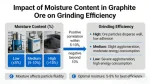
Moisture content is a critical process parameter for graphite grinding, with a non-linear impact on throughput, energy consumption, product quality (especially flake integrity for battery anodes), and equipment reliability. For most industrial applications:
- Dry grinding: Optimal moisture = 1–3 wt%; efficiency degrades sharply above 6 wt%.
- Wet grinding: Controlled moisture (as slurry solids loading = 60–80 wt%) prevents agglomeration and preserves graphite flakes, critical for lithium-ion battery anode production.
Core Mechanisms of Moisture Impact
Graphite’s unique layered crystal structure, hydrophobic surface, and association with clayey gangue make it highly sensitive to moisture. Key mechanisms include:
| Mechanism | Description | Impact on Grinding |
|---|---|---|
| Water Bridge Agglomeration | Excess moisture forms capillary bonds between fine graphite flakes, creating hard agglomerates that resist fracture. | Reduced particle breakage efficiency; coarser, inconsistent product. |
| Rheological Changes | Moisture increases bulk viscosity in dry mills and controls slurry viscosity in wet mills. | Dry mills: Poor flow, cake formation; Wet mills: Optimal viscosity improves particle collision. |
| Lubrication Amplification | Graphite’s natural lubricity is enhanced by moisture, causing grinding media to slide (instead of impact). | Reduced energy transfer to ore; higher energy consumption. |
| Gangue Bonding | Clay minerals in graphite ore absorb moisture, forming a sticky matrix that coats mill liners/media. | Reduced grinding action; increased wear and blockages. |
Specific Effects on Grinding Performance Metrics
1. Throughput & Capacity
- Excessive moisture (>6 wt%): Causes cake formation on vertical mill discs or coating of ball mill media/liners. This reduces feed rates by 20–50% and can lead to mill “bogging” (complete stoppage).
- Insufficient moisture (<1 wt%): Severe dusting reduces mill retention time, leading to under-grinding and lower effective throughput.
2. Energy Consumption
- High moisture: Increases energy use by 15–40% due to reduced impact efficiency, increased mill load, and frequent cleaning downtime.
- Low moisture: May increase energy by 5–10% due to uneven particle fracture and dust-related process inefficiencies.
3. Product Quality (Critical for Battery Anodes)
Graphite for lithium-ion battery anodes requires strict control of flake size, particle size distribution (PSD), and purity—all strongly affected by moisture:
- PSD Consistency: Excess moisture leads to coarser, bimodal PSD; insufficient moisture causes over-grinding of fines (reducing anode performance).
- Flake Integrity: High moisture in dry grinding causes uneven stress, fracturing large flakes (critical for high-capacity anodes); controlled wet grinding preserves flake structure.
- Purity: Moisture-trapped agglomerates can encapsulate gangue minerals, reducing concentrate purity by 3–10%.
4. Equipment Wear & Maintenance
- Increased Wear: Sticky material increases liner/media wear by 20–30% due to abrasive adhesion.
- Downtime: Blockages in classifiers, chutes, and feeders increase maintenance downtime by 30–60%.
Threshold Effects: Optimal vs. Excessive Moisture
The table below summarizes the impact of moisture levels on dry and wet grinding processes for graphite ore:
| Moisture Level (wt%) | Dry Grinding Outcome | Wet Grinding Outcome (Slurry Solids Loading) |
|---|---|---|
| <1 | Severe dusting, uneven fracture, low retention | Too dilute (solids <60%); high pumping energy, poor collision efficiency |
| 1–3 (Optimal) | Reduced dust, stable flow, efficient fracture | Balanced viscosity (60–80%); optimal dispersion, minimal flake damage |
| 3–6 (Marginal) | Mild agglomeration, 10–20% throughput loss | Slightly high viscosity; acceptable grinding but reduced classifier efficiency |
| >6 (Excessive) | Severe agglomeration, cake formation, mill bogging | Too thick (solids >80%); poor flow, reduced grinding efficiency |
Mitigation Strategies for Moisture-Related Issues
Pre-Treatment (Most Effective for High-Moisture Ore)
- Drying: Use rotary dryers or fluidized-bed dryers to reduce moisture to 1–3 wt% for dry grinding. Hot gas injection in air classifier mills can simultaneously dry and grind ore.
- Blending: Mix high-moisture ore with low-moisture stock to maintain stable moisture levels (critical for consistent process performance).
Process Optimization
- Dry Grinding:
- Adjust mill speed and media size to maximize impact (reduce sliding).
- Use anti-caking agents (e.g., silica fume) to break water bridges.
- Optimize classifier settings to remove agglomerates early.
- Wet Grinding (Battery Anode Graphite):
- Control slurry solids loading at 65–75 wt% and temperature at 25–40°C to prevent flake damage.
- Add dispersants (e.g., sodium hexametaphosphate) to improve particle dispersion and reduce viscosity.
Equipment Selection
- High-moisture ore: Vertical roller mills with scrapers, air classifier mills with hot gas, or wet bead mills.
- Flake graphite: Pebble mills or rod mills to minimize flake breakage (critical for high-value anode applications).
Key Takeaways for Industrial Practice
- Measure Moisture In-Line: Install real-time moisture sensors to monitor ore feed and adjust drying/grinding parameters dynamically.
- Match Process to Moisture: Use dry grinding for low-moisture ore (<3 wt%) and wet grinding for high-moisture ore or when flake integrity is critical.
- Prioritize Pre-Treatment: Drying high-moisture ore (>6 wt%) before dry grinding is more cost-effective than dealing with process inefficiencies and equipment damage.
By controlling moisture content within the optimal range, you can improve grinding efficiency by 20–30%, reduce energy consumption by 15–40%, and produce consistent, high-quality graphite for battery and other industrial applications.