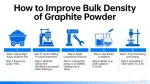
How to Improve Bulk Density of Graphite Powder

Bulk density = loose packing density (before tapping). Higher bulk density = better flow, less dust, less bridging, easier transportation. 1. Optimize Particle Size Distribution (Most Effective) Use wide particle size distribution (large + medium + small particles).Small particles fill gaps between large ones → higher packing density. Reduce ultra-fine powder (<3 μm) content.Too many fines cause agglomeration and increase voids → low bulk density. 2. Improve Particle Shape Spheroidize graphite particles (turn flake → spherical).Spherical particles pack much denser…

Bulk density = loose packing density (before tapping).

Higher bulk density = better flow, less dust, less bridging, easier transportation.

1. Optimize Particle Size Distribution (Most Effective)

  • Use wide particle size distribution (large + medium + small particles).Small particles fill gaps between large ones → higher packing density.
  • Reduce ultra-fine powder (<3 μm) content.Too many fines cause agglomeration and increase voids → low bulk density.

2. Improve Particle Shape

  • Spheroidize graphite particles (turn flake → spherical).Spherical particles pack much denser than flaky / irregular ones.
  • Smooth surfaces reduce friction → better flow and higher bulk density.

3. Remove Excess Fines with Air Classification

Use an air classifier to remove light, fine powder.Less fine dust → less agglomeration → higher bulk density.

4. Avoid Over-Grinding

Over-grinding creates massive amounts of ultra-fine particles,which lower bulk density drastically.Control grinding speed and circulation to keep a stable particle size.

5. Reduce Moisture & Agglomeration

  • Dry graphite powder properly (residual moisture < 0.5%).Moisture causes clumping → loose packing.
  • Eliminate static electricity to prevent agglomeration.

6. Light Surface Modification (Low Dosage)

Add a tiny amount of lubricant/modifier (e.g., stearic acid, graphite-specific modifier):

  • reduces inter-particle friction
  • improves flow
  • increases bulk density

7. Gentle Granulation (For Very Poor Flow)

Make micro-granules (soft, not hard pellets) to:

  • eliminate dust
  • greatly improve bulk density
  • make conveying / feeding much smoother

By combining classification + shape control + removing fines,you can often increase bulk density by 20–40%.
About Us:
With over 20 years of dedicated expertise in ultrafine grinding technology, we deliver high-performance machinery that matches the precision and reliability of leading German and Japanese brands—at only 1/3 of their cost.

Beyond Equipment, We Deliver Total Confidence:
We provide Free Material Testing to ensure precise equipment selection, followed by professional on-site installation and comprehensive training. Our 24/7 technical support team ensures your production line remains efficient and worry-free.

Schedule Material Trial & Get a Customized Solution from Us

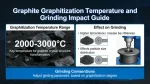
Graphitization is the high-temperature transformation of amorphous carbon into ordered graphite structure with hexagonal layers held by weak Van der Waals forces. The temperature requirements vary by application and material:…

15/03/2026

Expandable graphite (EG) is produced by inserting non-carbon atoms/molecules between flake graphite layers via grinding activation and chemical/electrochemical intercalation, creating graphite intercalation compounds (GICs) that expand dramatically when heated. Below…

14/03/2026

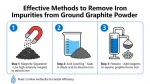
The most effective iron removal from ground graphite powder typically uses a multi-stage approach combining magnetic separation (for ferromagnetic particles) and chemical leaching (for oxidized and chemically bound iron), followed…

13/03/2026

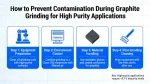
For high-purity graphite grinding (e.g., lithium-ion battery anode graphite with strict impurity requirements), contamination prevention needs a full-process control strategy covering equipment design/materials, grinding process, environmental management, material handling, and…

12/03/2026

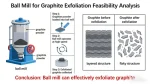
ball milling is a well-established and widely used method for the exfoliation of graphite to produce graphene (or few-layer graphene). It is considered one of the most promising techniques for the large-scale, cost-effective, and environmentally friendly production…

11/03/2026

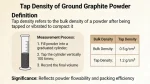
The tap density of ground graphite powder typically ranges from 0.10 g/cm³ to 1.30 g/cm³, with most common industrial values falling between 0.80 g/cm³ and 1.20 g/cm³ for battery-grade graphite…

10/03/2026

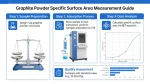
To measure the specific surface area (SSA) of graphite powder for quality assessment, the BET (Brunauer-Emmett-Teller) gas adsorption method is the industry standard (ISO 9277:2022, ASTM D8325-20) ASTM. It provides…

08/03/2026

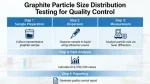
Quality control for graphite particle size requires representative sampling, proper dispersion to avoid agglomeration, and method matching to particle size range (sieving for >38 μm, laser diffraction for 0.1–1000 μm,…

07/03/2026

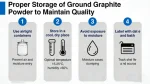
To maintain the quality of ground graphite powder, focus on controlling moisture, preventing oxidation, avoiding contamination, and managing physical degradation (agglomeration, particle size changes). Below is a structured approach to…

06/03/2026

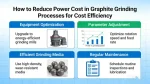
To reduce power costs in graphite grinding for cost efficiency, focus on equipment upgrades (20-60% savings), process optimization (15-30% savings), media selection (10-44% savings), automation (10-20% savings), and energy management…

05/03/2026