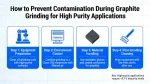
For high-purity graphite grinding (e.g., lithium-ion battery anode graphite with strict impurity requirements), contamination prevention needs a full-process control strategy covering equipment design/materials, grinding process, environmental management, material handling, and post-processing.
1. Select High-Purity, Wear-Resistant Equipment Contact Materials
Contamination from equipment component wear is the primary source of impurities, so all parts in direct contact with graphite must be made of high-purity, low-wear, non-reactive materials to avoid metal/non-metal particle shedding:
- Choose polished 316L/317L high-purity stainless steel, high-purity alumina (Al₂O₃), silicon carbide (SiC), or polytetrafluoroethylene (PTFE) for grinding discs, grinding blocks, gear rings, grinding rollers, and classification wheels (core grinding/classification components of vertical classifier mills, ring roller mills). Avoid ordinary carbon steel, low-grade alloy steel, or unpolished metal parts that are prone to rust and wear.
- Use high-purity ceramic or PTFE for feeders (screw feeders), splitter rings, and material throwing discs to prevent impurity introduction from material conveying and diversion.
- For sealing parts (e.g., shaft seals), adopt food/ultra-pure grade fluororubber or PTFE seals to avoid lubricating oil leakage and rubber particle shedding.
2. Optimize Equipment Structure for Closed & Dead-Corner-Free Grinding
Based on the integrated, closed grinding-classification design of the graphite equipment on the page, further optimize the structure to eliminate material accumulation, cross-contamination, and external air intrusion:
- Adopt a fully closed grinding system (from feeding to collection) to isolate graphite from the external environment. Avoid open feeding, conveying, or collection links that cause dust and impurity mixing.
- Eliminate dead corners and low-flow areas in the equipment (e.g., the horizontal heightened classifier mill optimizes flow field to remove <6m/s low-velocity zones) to prevent material long-term accumulation, caking, or secondary pollution from degraded materials.
- Separate grinding, classification, and air flow systems (e.g., independent classification chambers for horizontal heightened classifier mills) to avoid mutual interference between ascending air flow and coarse particle return air flow, and prevent impurity re-mixing in the circulation process.
- Equip the equipment with sealed negative pressure operation to avoid dust overflow and external air suction, and ensure air flow only circulates in the closed system.
3. Purify and Control Process Media (Air/Gas, Grinding Aids)
Graphite grinding relies on ascending air flow for material conveying and classification; the purity of the gas medium and rational use of grinding aids are critical for contamination prevention:
- Purify the process gas: Replace ordinary air with high-purity dry inert gas (N₂/Ar) for ultra-high purity graphite grinding (e.g., battery-grade graphite) to prevent oxidation and avoid impurity introduction from air dust, moisture, and oxygen. For air-based grinding, filter the air through HEPA/ULPA high-efficiency filters (0.1–0.3μm filtration accuracy) to remove particulate impurities, and dry it to a dew point below -40℃ to prevent moisture-induced graphite agglomeration and water-phase impurity adsorption.
- Avoid unnecessary grinding aids: Minimize the use of grinding aids; if necessary, select high-purity, low-residue, easily removable aids (e.g., high-purity alcohols) compatible with graphite, and design a subsequent purification process to completely remove aids to avoid organic contamination.
4. Implement Closed, Contamination-Free Material Handling
Contamination can also occur in raw material pretreatment, feeding, and finished product collection/ packaging; strict closed operation must be implemented for the entire material chain:
- Raw material pretreatment: Before grinding, purify the graphite raw material (e.g., high-temperature purification, acid washing) to remove surface adsorbed impurities, and store it in sealed high-purity containers (PTFE/high-purity stainless steel tanks) to avoid contact with ordinary plastic, paper, or metal containers.
- Closed conveying: Use sealed screw feeders (the standard configuration of the equipment on the page) or pneumatic conveying with high-purity gas for material feeding, instead of open belt conveying or manual feeding to prevent dust and human-made contamination.
- Pure collection & packaging: For finished product collection (cyclone collectors, dust collectors on the page), use high-purity PTFE filter bags (avoid ordinary fabric filter bags that shed fiber) for dust removal; collect the ground graphite powder in sealed, clean packaging (high-purity aluminum foil bags, PTFE barrels) immediately, and seal the packaging in a clean environment to prevent secondary contamination during storage and transportation.
5. Control the Grinding Environment to a Clean Room Standard
The production environment is an important factor for preventing external dust, particulate matter, and microbial contamination (for high-purity industrial graphite):
- Build a Class 10,000/Class 1,000 clean room for the graphite grinding workshop, maintain positive pressure in the clean room to prevent external dirty air from entering, and equip with constant temperature and humidity control (temperature 20–25℃, humidity 30–40%) to avoid moisture and static-induced impurity adsorption.
- Use non-dusting, easy-to-clean materials for the workshop’s ground, walls, and ceiling (e.g., epoxy resin, stainless steel), and install high-efficiency dust removal systems to eliminate floating dust in the air.
- Require operators to wear dust-free clothing, dust-free gloves, and anti-static shoe covers; prohibit bringing foreign objects into the clean room, and use clean, dedicated tools for equipment operation and maintenance to avoid human-made contamination.
6. Standardize Equipment Cleaning and Batch-to-Batch Cross-Contamination Prevention
For multi-specification, batch grinding production, strict cleaning procedures must be formulated to avoid cross-contamination between different batches or grades of graphite:
- Post-batch cleaning: After each grinding batch, use high-purity dry inert gas (N₂/Ar) to purge the entire closed system (grinding chamber, classification chamber, conveying pipeline, collector) to remove residual graphite powder; for heavy contamination, rinse with ultra-pure water (for water-resistant processes) or wipe with high-purity alcohol, then dry with high-purity gas to avoid cleaning agent residue.
- Special equipment for special grades: For ultra-high purity graphite (e.g., battery anode with ultra-low metal impurity requirements), use dedicated grinding equipment that is not shared with ordinary graphite grinding to eliminate cross-contamination risks.
- Regular maintenance and inspection: Periodically check the wear status of equipment contact parts (grinding blocks, classification wheels, grinding rollers); replace worn parts in a timely manner to avoid impurity increase caused by excessive wear, and clean the new parts before installation to remove surface oil and dust.
7. Optimize Grinding Process Parameters to Reduce Wear-Induced Contamination
Reasonable process parameters can reduce excessive wear of equipment and avoid secondary contamination from over-grinding:
- Control the grinding speed and grinding time (e.g., low-speed operation of ring roller mills on the page) to avoid excessive grinding that causes severe wear of grinding parts and particle shedding; adjust the air flow speed and classification wheel speed to ensure efficient separation of qualified powder and reduce material circulation times in the grinding chamber.
- Avoid over-feeding or insufficient feeding: Over-feeding causes material accumulation and increased grinding resistance (worsening wear); insufficient feeding leads to dry grinding of equipment parts, both of which will increase impurity introduction.
- For shaping systems (continuous/batch shaping systems) and pin mill depolymerization systems, control the mechanical force intensity and processing time to minimize surface damage of graphite particles and avoid impurity mixing from equipment wear during shaping/depolymerization.
8. Real-Time Monitoring and Post-Grinding Purification
Establish a full-process impurity detection system, and add post-grinding purification steps if necessary to ensure the final product meets high-purity requirements:
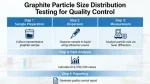
- On-line real-time detection: Install on-line impurity analyzers (e.g., laser particle counters, metal impurity on-line detectors) in the grinding and classification links to monitor the impurity content and particle size distribution of graphite powder in real time; stop the machine for troubleshooting immediately if the impurity exceeds the standard.
- Off-line sampling detection: Conduct off-line detection on the finished product using high-precision detection methods (ICP-MS for metal impurity detection, XRF for non-metal impurity detection) to ensure the impurity content meets the high-purity application standard (e.g., battery anode graphite with metal impurities at the ppm/ppb level).
- Post-grinding purification: If necessary, add a post-grinding purification step (e.g., high-temperature degassing, ultra-fine classification, or acid washing with high-purity acid) to remove trace impurities introduced during grinding, and then dry with high-purity gas to ensure the final graphite powder purity.