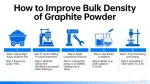
How to Improve Bulk Density of Graphite Powder

Bulk density = loose packing density (before tapping). Higher bulk density = better flow, less dust, less bridging, easier transportation. 1. Optimize Particle Size Distribution (Most Effective) Use wide particle size distribution (large + medium + small particles).Small particles fill gaps between large ones → higher packing density. Reduce ultra-fine powder (<3 μm) content.Too many fines cause agglomeration and increase voids → low bulk density. 2. Improve Particle Shape Spheroidize graphite particles (turn flake → spherical).Spherical particles pack much denser…

Bulk density = loose packing density (before tapping).

Higher bulk density = better flow, less dust, less bridging, easier transportation.

1. Optimize Particle Size Distribution (Most Effective)

  • Use wide particle size distribution (large + medium + small particles).Small particles fill gaps between large ones → higher packing density.
  • Reduce ultra-fine powder (<3 μm) content.Too many fines cause agglomeration and increase voids → low bulk density.

2. Improve Particle Shape

  • Spheroidize graphite particles (turn flake → spherical).Spherical particles pack much denser than flaky / irregular ones.
  • Smooth surfaces reduce friction → better flow and higher bulk density.

3. Remove Excess Fines with Air Classification

Use an air classifier to remove light, fine powder.Less fine dust → less agglomeration → higher bulk density.

4. Avoid Over-Grinding

Over-grinding creates massive amounts of ultra-fine particles,which lower bulk density drastically.Control grinding speed and circulation to keep a stable particle size.

5. Reduce Moisture & Agglomeration

  • Dry graphite powder properly (residual moisture < 0.5%).Moisture causes clumping → loose packing.
  • Eliminate static electricity to prevent agglomeration.

6. Light Surface Modification (Low Dosage)

Add a tiny amount of lubricant/modifier (e.g., stearic acid, graphite-specific modifier):

  • reduces inter-particle friction
  • improves flow
  • increases bulk density

7. Gentle Granulation (For Very Poor Flow)

Make micro-granules (soft, not hard pellets) to:

  • eliminate dust
  • greatly improve bulk density
  • make conveying / feeding much smoother

By combining classification + shape control + removing fines,you can often increase bulk density by 20–40%.

About Us:
With over 20 years of dedicated expertise in ultrafine grinding technology, we deliver high-performance machinery that matches the precision and reliability of leading German and Japanese brands—at only 1/3 of their cost.

Beyond Equipment, We Deliver Total Confidence:
We provide Free Material Testing to ensure precise equipment selection, followed by professional on-site installation and comprehensive training. Our 24/7 technical support team ensures your production line remains efficient and worry-free.

Schedule Material Trial & Get a Customized Solution from Us

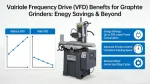
VFDs deliver substantial energy savings (typically 15-40%) for graphite grinders by matching motor speed to actual load demand, optimizing process efficiency, and reducing mechanical stress. The greatest savings occur when…

22/03/2026

For high-speed graphite mills, prioritize clean, low-viscosity synthetic lubricants with EP additives, use oil-air lubrication for spindle/classifier bearings, implement sealed systems + kidney-loop filtration, and enforce strict contamination control (graphite…

22/03/2026

Graphite ore processing faces significant challenges from abrasive gangue minerals, primarily quartz (Mohs hardness 7), feldspar (6-6.5), and iron sulfides, which cause accelerated wear in grinding equipment while also damaging…

22/03/2026

Graphite jet mills rely on particle-particle collisions for comminution, minimizing direct material-to-wall contact compared to mechanical mills. However, key components still experience wear due to high-velocity particle impacts, especially in…

21/03/2026

Abrasive impurities—especially quartz (SiO₂, Mohs 7) and pyrite (FeS₂, Mohs 6–6.5)—are the primary drivers of accelerated wear in graphite ore mills, costing operations 15–30% higher maintenance and reducing equipment life…

21/03/2026

Graphite grinding operations present significant explosion hazards due to the combustible nature of graphite dust, which forms explosive clouds when suspended in air. This guide outlines mandatory safety requirements based…

21/03/2026

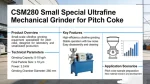
Developed and manufactured with authentic German technology combined with sophisticated Chinese manufacturing, the CSM280 small ultrafine mechanical grinder is specially designed for grinding pitch coke. It is also compatible with…

20/03/2026

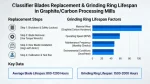
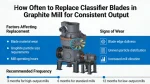
Quick Reference: Component Typical Replacement Interval Key Wear Indicators Graphite Mill Classifier Blades 4,000–8,000 operating hours (6–12 months) Inconsistent particle size, increased energy consumption, visible wear >0.1mm Carbon Processing VRM…

20/03/2026

Classifier blade replacement frequency depends on multiple factors, but for graphite mills (Mohs hardness 1-2, relatively low abrasiveness), the general guideline is 6-12 months for rotor blades and 8-15 months…

20/03/2026

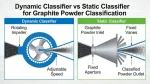
For graphite powder classification—especially critical for battery anode applications demanding narrow PSD (particle size distribution) and precise control—the core trade-off is precision and adjustability (dynamic) versus simplicity and low operational…

19/03/2026