what is the hardness of graphite on mohs scale and its impact on grinding

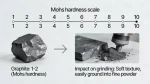
Graphite has a Mohs hardness of 1 to 2, making it one of the softest known minerals. This low hardness significantly influences its behavior during grinding and machining processes. Impact of Low Hardness on Grinding: Easy to Grind: Due to its softness, graphite is readily abraded or crushed with minimal mechanical force. This makes it energy-efficient to grind compared to harder materials like quartz (Mohs 7) or corundum (Mohs 9). Lubricating Properties: Graphite’s layered crystal structure allows sheets to slide over one another easily,…

Graphite has a Mohs hardness of 1 to 2, making it one of the softest known minerals. This low hardness significantly influences its behavior during grinding and machining processes.

Impact of Low Hardness on Grinding:

  1. Easy to Grind:
    Due to its softness, graphite is readily abraded or crushed with minimal mechanical force. This makes it energy-efficient to grind compared to harder materials like quartz (Mohs 7) or corundum (Mohs 9).
  2. Lubricating Properties:
    Graphite’s layered crystal structure allows sheets to slide over one another easily, giving it natural lubricity. During grinding, this can reduce friction between particles and grinding media, potentially lowering wear on equipment—but also possibly reducing grinding efficiency if slippage occurs.
  3. Fines Generation:
    The softness leads to rapid formation of fine powders or dust, which can pose handling and health concerns (e.g., inhalation risks). Dust control measures (e.g., ventilation, wet grinding) are often necessary.
  4. Abrasive Wear on Equipment Is Low:
    Unlike hard minerals that rapidly wear down grinding media (e.g., steel balls or ceramic liners), graphite causes minimal abrasive wear, extending equipment life.
  5. Contamination Sensitivity:
    Because graphite is so soft, even small amounts of harder contaminants (e.g., silica or metal fragments) can dominate the wear behavior and damage processing equipment or degrade product purity—especially critical in applications like lithium-ion battery anodes.
  6. Agglomeration Tendency:
    Fine graphite particles can stick together due to van der Waals forces, requiring additives or surface treatments to maintain dispersion during or after grinding.

Practical Applications:

  • In refractoriesbatteries, and lubricants, graphite is often ground to specific particle sizes. Its softness allows precise size control but demands careful process design to avoid excessive fines or dust.
  • In pencil manufacturing, the softness directly relates to the “lead” grade (e.g., HB, 2B)—softer graphite produces darker, smoother marks.
In summary, graphite’s low Mohs hardness (1–2) makes it easy and economical to grind, but requires attention to dust control, contamination, and particle agglomeration in industrial settings.
About Us:
With over 20 years of dedicated expertise in ultrafine grinding technology, we deliver high-performance machinery that matches the precision and reliability of leading German and Japanese brands—at only 1/3 of their cost.

Beyond Equipment, We Deliver Total Confidence:
We provide Free Material Testing to ensure precise equipment selection, followed by professional on-site installation and comprehensive training. Our 24/7 technical support team ensures your production line remains efficient and worry-free.

Schedule Material Trial & Get a Customized Solution from Us

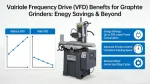
VFDs deliver substantial energy savings (typically 15-40%) for graphite grinders by matching motor speed to actual load demand, optimizing process efficiency, and reducing mechanical stress. The greatest savings occur when…

22/03/2026

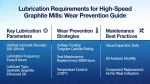
For high-speed graphite mills, prioritize clean, low-viscosity synthetic lubricants with EP additives, use oil-air lubrication for spindle/classifier bearings, implement sealed systems + kidney-loop filtration, and enforce strict contamination control (graphite…

22/03/2026

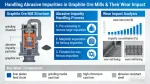
Graphite ore processing faces significant challenges from abrasive gangue minerals, primarily quartz (Mohs hardness 7), feldspar (6-6.5), and iron sulfides, which cause accelerated wear in grinding equipment while also damaging…

22/03/2026

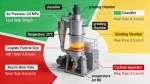
Graphite jet mills rely on particle-particle collisions for comminution, minimizing direct material-to-wall contact compared to mechanical mills. However, key components still experience wear due to high-velocity particle impacts, especially in…

21/03/2026

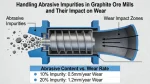
Abrasive impurities—especially quartz (SiO₂, Mohs 7) and pyrite (FeS₂, Mohs 6–6.5)—are the primary drivers of accelerated wear in graphite ore mills, costing operations 15–30% higher maintenance and reducing equipment life…

21/03/2026

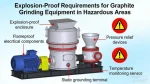
Graphite grinding operations present significant explosion hazards due to the combustible nature of graphite dust, which forms explosive clouds when suspended in air. This guide outlines mandatory safety requirements based…

21/03/2026

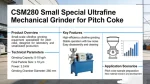
Developed and manufactured with authentic German technology combined with sophisticated Chinese manufacturing, the CSM280 small ultrafine mechanical grinder is specially designed for grinding pitch coke. It is also compatible with…

20/03/2026

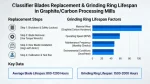
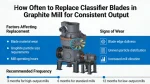
Quick Reference: Component Typical Replacement Interval Key Wear Indicators Graphite Mill Classifier Blades 4,000–8,000 operating hours (6–12 months) Inconsistent particle size, increased energy consumption, visible wear >0.1mm Carbon Processing VRM…

20/03/2026

Classifier blade replacement frequency depends on multiple factors, but for graphite mills (Mohs hardness 1-2, relatively low abrasiveness), the general guideline is 6-12 months for rotor blades and 8-15 months…

20/03/2026

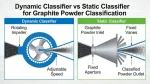
For graphite powder classification—especially critical for battery anode applications demanding narrow PSD (particle size distribution) and precise control—the core trade-off is precision and adjustability (dynamic) versus simplicity and low operational…

19/03/2026