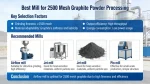
For 2500 mesh (approximately 5 μm) graphite powder processing, the optimal mill depends on your priorities: purity, particle size distribution (PSD) control, production scale, energy efficiency, and application requirements (e.g., battery anode, lubricants, conductive materials). Below is a structured comparison of the most suitable technologies.
Key Mill Options for 2500 Mesh Graphite Powder
1. Fluidized Bed Opposed Jet Mill (Top Choice for Battery-Grade Graphite)
Core Principle: Particles suspended in high-velocity air/nitrogen collide at supersonic speeds (300–500 m/s) with no mechanical grinding media contact .Best For: High-purity, narrow PSD, and spherical graphite (critical for lithium-ion battery anodes) .
Advantages:
- Ultra-low contamination: No metal/grinding media contact (Fe content ≤10 ppm)
- Precise PSD control: D97 ≤5 μm with steep distribution and sharp top-size cutoff
- Low-temperature grinding: Prevents graphite oxidation/degradation
- Spheroidization capability: Converts flaky graphite to spherical particles for better packing density
- Scalable: From lab (kg/h) to industrial (ton/h) scales
Limitations:
- Higher capital cost than mechanical mills
- Higher energy consumption for fine grinding
- Requires clean, dry compressed air/nitrogen supply
Recommended Models: Hosokawa Alpine AFG series, Sugino Jet Mill, EPIC Fluidized Bed Jet Mill
2. HLMX/HCH Ultra-Fine Vertical Mill (Best for Large-Scale Industrial Production)
Core Principle: Roller pressure, grinding, and impact with built-in precision classifiers .Best For: High-throughput (15–35 t/h for HLMX2200), cost-effective production of general-purpose 2500 mesh graphite .
Advantages:
- Energy-efficient: 30% lower power consumption than traditional mills
- Integrated drying: Handles feed moisture up to 6%
- Modular design: Easy maintenance with secondary classification for consistent fineness
- Wide range: 325–2500 mesh adjustable (5–45 μm)
Limitations:
- Minor mechanical wear/contamination (less critical for non-battery applications)
- Limited spheroidization capability compared to jet mills
Recommended Models: Guilin Hongcheng HLMX series, HCH Ultra-Fine Ring Roller Mill
3. HGM Micro-Powder Grinding Mill (Best for Medium-Scale, Cost-Sensitive Processing)
Core Principle: Three-ring roller design with multi-head cage-type classifiers .Best For: General industrial applications (lubricants, brake linings, conductive pastes) requiring 5 μm graphite powder at moderate volumes (0.5–45 t/h) .
Advantages:
- Cost-effective: Lower investment than jet mills
- Flexible fineness: 325–2500 mesh (5–47 μm) adjustable
- High classification efficiency: D97 ≤5 μm with forced turbine system
- Low dust emissions: Pulse dust collection ≥99.9%
Limitations:
- Some mechanical wear (use ceramic/PU liners for higher purity)
- Broader PSD than jet mills
Recommended Models: Clirik HGM series, Baichy HGM Micro-Powder Mill
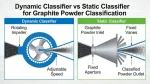
4. Air Classifier Mill (Best for Pre-Grinding + Spheroidization)
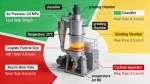
Core Principle: Mechanical impact grinding with integrated precision air classification .Best For: Pre-processing graphite to 10–20 μm before jet milling or producing spherical graphite with controlled morphology .
Advantages:
- Combined grinding/classification: Single-pass processing
- Low oxidation risk: Lower temperature than ball mills
- Adjustable fineness: D97 = 5–45 μm
Limitations:
- Higher contamination than jet mills (mechanical wear)
- Less efficient for D50 <5 μm compared to fluidized bed jet mills
Comparative Analysis Table
| Mill Type | Purity Level | PSD Control | Energy Efficiency | Spheroidization | Production Scale | Best Application |
|---|---|---|---|---|---|---|
| Fluidized Bed Jet Mill | Ultra-high (99.99%) | Excellent (narrow) | Moderate | Excellent | Lab to Industrial | Battery Anode Material |
| HLMX Vertical Mill | High | Good | Excellent | Limited | Large (15–35 t/h) | General Industrial Bulk Production |
| HGM Micro-Powder Mill | Medium-High | Good | Good | None | Medium (0.5–45 t/h) | Lubricants, Conductive Additives |
| Air Classifier Mill | Medium | Fair | Good | Good | Small-Medium | Pre-Grinding, Spheroidization |
Final Recommendations by Application
- Battery Anode Graphite (Most Demanding):Choose a Fluidized Bed Opposed Jet Mill for ultra-purity, narrow PSD, and spherical particle shape . This ensures optimal electrode performance, fast charging, and cycle stability.
- Large-Scale Industrial Production (Non-Battery):Select an HLMX Ultra-Fine Vertical Mill for energy efficiency and high throughput (15–35 t/h) . Ideal for cost-sensitive applications like brake pads, gaskets, and industrial lubricants.
- Medium-Scale General Applications:Use an HGM Micro-Powder Mill for balanced cost, efficiency, and fineness control . Suitable for conductive pastes, rubber fillers, and refractory materials.
- Spheroidization + Fine Grinding:Combine an Air Classifier Mill (pre-grinding/spheroidization) with a Fluidized Bed Jet Mill (final ultra-fine grinding) for best results .
Critical Process Considerations
- Feed Preparation:
- Pre-crush graphite to ≤10–20 mm for optimal mill efficiency
- Dry to ≤5% moisture content (critical for jet mills and vertical mills)
- Post-Processing:
- Install pulse bag filters (efficiency ≥99.9%) for dust control
- Use inert gas (nitrogen) for high-purity applications to prevent oxidation
- Quality Control:
- Verify particle size with laser diffraction (D10, D50, D97)
- Check purity (ash content, Fe, Si) using ICP-MS
- Assess morphology via SEM for battery applications