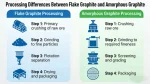
The core difference in processing flake graphite vs amorphous graphite (also called cryptocrystalline or microcrystalline graphite) stems from their distinct mineral structures: flake graphite has visible, larger, layered crystals with high natural floatability, while amorphous graphite consists of tiny, intergrown microcrystals with poor floatability but often higher natural grade . These differences drive divergent approaches to crushing, grinding, beneficiation, purification, and product handling.
Key Structural & Mineralogical Differences
| Characteristic | Flake Graphite | Amorphous Graphite | Impact on Processing |
|---|---|---|---|
| Crystal size | Visible flakes (147 μm to several mm) | Microcrystalline (<1 μm), only seen under electron microscope | Flake preservation is critical; amorphous requires fine grinding for liberation |
| Natural grade | Typically 80-95% C | Higher, 60-90% C (sometimes >90%) | Amorphous may need less purification; flake needs more enrichment |
| Floatability | Excellent natural hydrophobicity | Poor floatability (selectivity low) | Flake uses standard flotation; amorphous needs aggressive reagents/multi-stage grinding |
| Structure | Layered, anisotropic | Aggregated, intergrown, isotropic | Flake grinding must avoid flake destruction; amorphous requires thorough dissociation |
1. Crushing & Grinding Processes
Flake Graphite:
- Primary goal: Liberation while preserving flake size (especially large flakes with higher value)
- Equipment: Jaw crushers → cone crushers → rod mills (preferred for minimizing flake breakage) or ball mills
- Grinding approach: Single-stage or limited regrinding; once target fineness is reached, further grinding has minimal effect
- Concentration strategy: Foam products concentrated before regrinding to improve efficiency
Amorphous Graphite:
- Primary goal: Complete liberation of microcrystals from gangue through fine grinding
- Equipment: Jaw crushers → impact crushers → high-efficiency stirring mills/planetary mills (for ultra-fine grinding)
- Grinding approach: Multi-stage gradual grinding (fineness improves with more stages)
- Concentration strategy: Higher grinding concentrations (using ball mills) to save time
2. Beneficiation & Flotation
Flake Graphite:
- Core process: Flotation is highly effective (natural floatability)
- Circuit: Rougher → cleaner → scavenger with middling returns to previous stages
- Reagents: Lower collector/foaming agent dosage; stable performance
- Product handling: Size classification preserves flake dimensions (jumbo, large, medium, small, fine)
- Equipment: SF, JJF, KYF flotation cells
Amorphous Graphite:
- Core challenge: Poor floatability due to microcrystalline structure and embedded impurities
- Circuit: Multi-stage grinding + multiple separations + coarse concentrate regrinding/re-dressing
- Reagents: Significantly higher dosage required for same flotation effect ; excessive reagents can reduce concentrate grade
- Product handling: Middle ore treated separately (not returned to main circuit, as it worsens flotation indices)
- Alternative: Many operations skip flotation and use direct grinding/sizing (due to high natural grade)
3. Purification Technologies
Flake Graphite:
- Typical path: Flotation → acid leaching (HCl/HF) → high-temperature purification (for ultra-high purity)
-
- Flake preservation critical during all steps
- Expandable graphite production (intercalation with acids)
- Applications drive purification intensity (batteries require >99.95% C)Special processes
Amorphous Graphite:
- Options vary by starting grade and target purity:
| Method | Process | Purity Achieved | Industrial Status |
|---|---|---|---|
| Direct grinding | Crush → grind → screen | As-mined grade (60-90% C) | Most common for low-end uses |
| Flotation | Multi-stage with aggressive reagents | 80-85% C | Limited applications |
| Acid-base | Alkali fusion (NaOH >600°C) → acid leach | 96-99% C | Lab-scale, limited industrial use |
| Mixed acid | HF-HCl or NH4F-HCl systems | 99.1-99.97% C | High efficiency but hazardous |
| High-temperature | Chlorination roasting or 2700°C vacuum heating | 99.99% C | Specialized, high-cost |
4. Product Handling & Applications
Flake Graphite:
- Size classification critical (market premiums for large flakes)
- Products:
- Expandable graphite (jumbo/large flakes)
- Battery materials (medium/small/fine flakes)
- Refractories, lubricants, composites
- Value chain: Premium pricing for larger flakes and high-purity products
Amorphous Graphite:
- Particle shaping often emphasized (spheroidization for battery applications)
- Common products:
- Ground powder (casting, grounding resistance reduction)
- Sieve particles (steelmaking carbon additives)
- Briquettes/balls (steelmaking heating agents, protection slag)
- Battery anode materials (after purification and shaping)
- Value chain: Lower cost, bulk applications dominate; high-end uses require intensive processing
5. Key Processing Challenges & Solutions
Flake Graphite Challenges:
- Flake breakage during grinding: Use rod mills, controlled grinding intensity, staged liberation
- Contaminant removal: Multi-stage flotation with selective reagents
- Size fraction control: Precision screening/hydrocycloning
Amorphous Graphite Challenges:
- Poor liberation: Ultra-fine grinding with high-energy mills
- Low flotation efficiency: Multi-stage circuits + optimized reagent regimes
- Purification costs: Balance between acid consumption and product value
Summary of Processing Flowcharts
Flake Graphite Processing:
Mining → Crushing (jaw → cone) → Rod milling (flake preservation) → Flotation (rougher-cleaner-scavenger) → Middling return → Dehydration → Acid leaching → High-temperature purification (optional) → Size classification → Packaging → High-value applications (batteries, expandable graphite)
Amorphous Graphite Processing:
Mining → Crushing (jaw → impact) → Fine grinding (stirring/planetary mills) → Optional flotation (multi-stage) → Middling separate treatment → Direct sizing (most common) or purification (acid-base/mixed acid) → Particle shaping (spheroidization) → Briquetting/packaging → Bulk applications (steel, casting) or specialized uses (batteries)
Critical Processing Takeaways
- Flake graphite processing prioritizes flake preservation and leverages its excellent natural floatability with standard flotation circuits .
- Amorphous graphite processing emphasizes fine grinding for liberation and requires aggressive beneficiation/purification (or skips flotation entirely due to higher natural grade) .
- Economic drivers: Flake graphite commands higher prices and justifies complex processing; amorphous graphite relies on low-cost routes for bulk markets, with high-purity variants requiring significant investment .
Understanding these differences is essential for selecting optimal equipment, designing circuits, and maximizing value recovery from each graphite type.