How to Automate a Graphite Powder Production Line for Continuous Operation

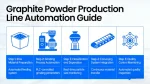
Automation for continuous running is built around closed-loop control, automatic material transfer, online monitoring, and interlock protection — eliminating manual feeding, screening, adjusting, and packaging. 1. Full-Line Continuous Structure Design Replace batch operation with a truly closed-loop, continuous flow: Raw material silo → automatic feeding → coarse grinding → ultrafine grinding → classification → drying/purification → dust removal → finished product silo → automatic packaging All stages connect via closed pneumatic/gravity conveying to avoid manual transfer. 2. Automated Raw Material…

Automation for continuous running is built around closed-loop control, automatic material transfer, online monitoring, and interlock protection — eliminating manual feeding, screening, adjusting, and packaging.

1. Full-Line Continuous Structure Design

Replace batch operation with a truly closed-loop, continuous flow: Raw material silo → automatic feeding → coarse grinding → ultrafine grinding → classification → drying/purification → dust removal → finished product silo → automatic packaging
All stages connect via closed pneumatic/gravity conveying to avoid manual transfer.

2. Automated Raw Material Handling

  • Bulk silos with radar/ultrasonic level sensors
  • Loss-in-weight feeders for high-precision constant feeding
  • Automatic switching between silos to ensure no interruption
  • Pneumatic conveying to keep graphite clean and dust-free

3. Autonomous Grinding & Classification (Core Section)

The grinding system runs fully automatically:
  • PID-controlled mill speed, air volume, feeding rate, and cooling temperature
  • Online laser particle size analyzer → real-time data → automatic adjustment of classifier speed
  • Closed-circuit grinding: oversized particles automatically return to mill
  • Cooling system (water/gas) controlled by temperature sensors
  • Overload / overheat / blockage → automatic slowdown or alarm
This keeps particle size stable without manual tuning.

4. Automatic Drying & Purification

  • Continuous dryer with online moisture sensor
  • Temperature and feeding speed automatically adjusted
  • Automatic magnetic separation (iron removal)
  • Self-cleaning screens with blockage detection

5. Automatic Dust Collection & Environmental Control

  • Baghouse filter with automatic pulse cleaning
  • Negative pressure auto-controlled
  • Dust concentration & oxygen monitoring
  • Explosion-proof interlock for graphite dust safety

6. Central Control System (PLC + SCADA)

The brain of continuous operation:
  • PLC (Siemens/Allen-Bradley) controls all equipment
  • SCADA shows real-time: temperature, pressure, flow, particle size, level, power
  • Sequence interlock: Start/stop in safe order; local fault does not shut down the whole line
  • Remote monitoring + alarm (App/SMS)
  • Fault self-diagnosis

7. Automatic Finished Product Storage & Packaging

  • Finished product silo with level control
  • Auto weighing & bagging (25kg / jumbo bag)
  • Automatic sealing, labeling, palletizing
  • Robotic palletizer + AGV to warehouse

8. Key Features for True 24/7 Continuity

  • Redundant components: backup pumps, sensors, fans
  • Unattended mode: night/weekend automatic operation
  • Self-protection logic: overtemp → reduce feed; blockage → reverse; low material → wait
  • Data logging & traceability for quality and production
About Us:
With over 20 years of dedicated expertise in ultrafine grinding technology, we deliver high-performance machinery that matches the precision and reliability of leading German and Japanese brands—at only 1/3 of their cost.

Beyond Equipment, We Deliver Total Confidence:
We provide Free Material Testing to ensure precise equipment selection, followed by professional on-site installation and comprehensive training. Our 24/7 technical support team ensures your production line remains efficient and worry-free.

Schedule Material Trial & Get a Customized Solution from Us

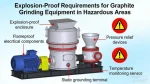
Graphite grinding operations present significant explosion hazards due to the combustible nature of graphite dust, which forms explosive clouds when suspended in air. This guide outlines mandatory safety requirements based…

21/03/2026

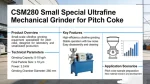
Developed and manufactured with authentic German technology combined with sophisticated Chinese manufacturing, the CSM280 small ultrafine mechanical grinder is specially designed for grinding pitch coke. It is also compatible with…

20/03/2026

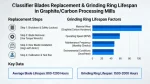
Quick Reference: Component Typical Replacement Interval Key Wear Indicators Graphite Mill Classifier Blades 4,000–8,000 operating hours (6–12 months) Inconsistent particle size, increased energy consumption, visible wear >0.1mm Carbon Processing VRM…

20/03/2026

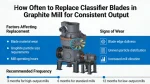
Classifier blade replacement frequency depends on multiple factors, but for graphite mills (Mohs hardness 1-2, relatively low abrasiveness), the general guideline is 6-12 months for rotor blades and 8-15 months…

20/03/2026

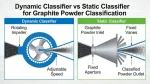
For graphite powder classification—especially critical for battery anode applications demanding narrow PSD (particle size distribution) and precise control—the core trade-off is precision and adjustability (dynamic) versus simplicity and low operational…

19/03/2026

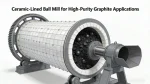
Ceramic-lined ball mills are critical equipment in high-purity graphite processing, designed specifically to maintain ultra-low contamination levels while achieving precise particle size reduction. These mills replace traditional steel liners and…

19/03/2026

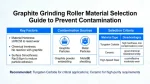
To prevent contamination in graphite grinding, prioritize non-metallic/chemically inert materials with ultra-low wear rates and minimal chemical interaction with graphite. Battery-grade graphite (iron <10 ppm) demands the strictest controls; industrial…

19/03/2026

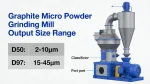
The output size range of micro powder grinding mills for graphite typically spans 5–47 μm (2500–325 mesh) as a standard range, with some models extending to 80–3000 mesh (1.6–150 μm)…

18/03/2026

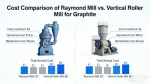
Raymond Mill: 30-40% lower initial investment than vertical roller mills (VRMs), ideal for small-to-medium scale (≤10 t/h) with limited budgets. Higher unit energy consumption (20-50% more than VRM) and shorter…

18/03/2026

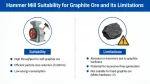
Hammer mills are suitable for graphite ore in coarse-to-medium crushing stages (0-3mm output) , especially for amorphous graphite or pre-processing crystalline graphite before beneficiation. However, they have critical limitations for…

18/03/2026