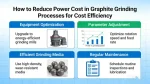
To reduce power costs in graphite grinding for cost efficiency, focus on equipment upgrades (20-60% savings), process optimization (15-30% savings), media selection (10-44% savings), automation (10-20% savings), and energy management (10-30% savings). Below is a structured, actionable playbook.
1. Equipment Selection: The Foundation of Energy Efficiency
| Equipment Type | Energy Savings | Best Applications | Key Advantages |
|---|---|---|---|
| Stirred Media Mills/Bead Mills | 30-40% vs. ball mills | Ultrafine grinding (<10μm) | Shorter processing time (72h → 10min), higher energy density |
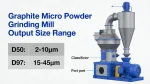
| Air Classifier Mills | 20-30% | Spherical graphite, anode materials | Built-in classifier prevents over-grinding, optimized airflow design |
| High-Pressure Grinding Rolls (HPGR) | Up to 30% | Coarse grinding | Layered crushing reduces energy per ton, protects graphite flakes |
| Ultrafine Graphite Mills | 30-50% vs. conventional mills | Anode materials | Specialized design for graphite properties, efficient particle size control |
| NETZSCH GyRho System | 60% energy reduction | Spheroidization | Compact design, fewer machines, 90% lower maintenance costs |
Implementation Tips:
- Replace outdated ball mills with stirred media mills for fine grinding applications
- Install HPGR in the pre-grinding stage to reduce energy consumption in subsequent grinding steps
- Use air classifier mills for spherical graphite production to eliminate separate classification steps
2. Process Optimization: Fine-Tuning for Maximum Efficiency
A. Grinding Circuit Design
- Adopt multi-stage grinding with progressively smaller media: 1st stage (Φ80mm alloy steel bars), 2nd stage (Φ40mm zirconia balls), 3rd stage (Φ6mm ceramic beads)
- Avoid over-grinding: Install real-time particle size analyzers to stop grinding when target fineness is reached (saves 15-25% energy)
- Optimize circuit configuration: Use 三段式 grinding for flake graphite (avoid 四段式 which increases energy without proportional yield gains)
B. Operational Parameters
- Maintain optimal solids concentration: 65-75% for wet grinding (improves grinding efficiency, reduces energy per unit of product)
- Adjust mill speed: Operate at 75-85% of critical speed for ball mills (maximizes grinding efficiency)
- Use dispersants: LS-SDS mixed dispersant improves grinding performance and reduces energy consumption in wet grinding
- Implement closed-loop systems: Recirculate only undersized particles, preventing over-processing of already 合格 material
C. Pre-Crushing Optimization
- Reduce feed size: Every 10% reduction in feed size decreases grinding energy by 5-8%
- Implement slow compression crushing (CCC method) for primary crushing (most energy-efficient way to break ore)
- Use variable-frequency feeders to maintain stable loading, avoiding no-load running or overload (saves 5-10% energy)
3. Grinding Media Selection: Small Changes, Big Savings
- Smaller media = higher efficiency: In ball mills, replacing 25mm media with smaller sizes yields 10-44% power savings; in vertical stirred mills, 20-60% savings
- Material selection:
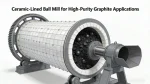
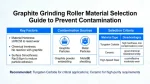
- Ceramic balls: Lower energy consumption for non-metallic ores like graphite, reduces contamination
- Zirconia beads: High density for efficient grinding, ideal for intermediate stages
- Composite media systems: Different materials for different grinding stages optimize energy use
- Media size ratio: Balls should be at least three times larger than the largest graphite particles for optimal impact energy
4. Automation and Digitalization: Smart Control for Energy Efficiency
- Install Variable Frequency Drives (VFDs): Reduce motor energy consumption by 20-50% (payback in 6-12 months)
- A 20% speed reduction yields ≈50% energy savings (Power ∝ Speed³)
- Implement AI-driven process control: Real-time adjustment of parameters based on sensor data (saves 10-20% energy)
- Deploy predictive maintenance: AI systems predict equipment failures, reducing downtime by 30% and maintenance costs by 20%
- Use SCADA systems: Centralized monitoring of all grinding parameters to identify energy waste points
- Implement “internal electricity trading”: Set internal electricity prices to incentivize energy-saving behaviors across departments
5. Pre-Processing and Feed Preparation
- Upgrade pre-crushing equipment: Use energy-efficient jaw crushers and cone crushers with optimized chamber designs (saves 10-30% energy)
- Remove gangue before grinding: Implement pre-concentration steps to reduce unnecessary grinding of low-grade materials
- Dry feed properly: Use microwave dryers (40% more energy-efficient than traditional dryers) to reduce moisture content before grinding
- Classify feed by size: Send different particle sizes to appropriate grinding stages to optimize energy use
6. Energy Management and Recovery
- Recover waste heat: Install heat exchangers to capture heat from grinding processes for preheating feed or facility heating (saves 5-15% energy)
- Optimize compressed air systems: Leak detection and pressure optimization reduce energy consumption by 10-20%
- Implement peak load management: Shift grinding operations to off-peak hours when electricity rates are lower (saves 15-30% on power costs)
- Use energy-efficient motors: Replace standard motors with IE3/IE4 premium efficiency motors (saves 3-5% energy)
- Conduct regular energy audits: Identify energy waste points and prioritize improvements based on ROI
7. Cost-Benefit Analysis: Ensuring ROI
Calculate Potential Savings:
Annual Energy Savings ($) = (Current kWh/t – Optimized kWh/t) × Annual Production (t) × Electricity Cost ($/kWh)
Typical ROI Scenarios:
- VFD installation: 6-12 months payback, 20-50% energy savings
- Stirred media mill replacement: 1-2 years payback, 30-40% energy savings
- Process optimization (no capital cost): Immediate savings, 10-20% energy reduction
Benchmark Power Consumption:
- Graphite ore grinding: 11-40 kWh/t (Bond Work Index: 11.05-13.25 kWh/t)
- Spherical graphite production: 12,000-20,000 kWh/t (electricity cost accounts for ~30% of total production cost)
8. Implementation Roadmap: Step-by-Step Approach
- Audit current operations: Measure power consumption per ton, identify bottlenecks and over-grinding issues
- Prioritize low-cost/no-cost measures: Optimize parameters, implement VFDs, improve feed preparation (quick wins)
- Upgrade key equipment: Replace inefficient mills with energy-efficient alternatives based on ROI analysis
- Implement automation: Install process control systems and monitoring tools for continuous optimization
- Train personnel: Educate operators on energy-saving practices and parameter optimization
- Monitor and adjust: Regularly review energy consumption data and fine-tune processes for maximum efficiency
Key Takeaways
Reducing power costs in graphite grinding requires a holistic approach combining equipment upgrades, process optimization, media selection, and digitalization. By implementing these strategies, you can achieve 20-60% energy savings, significantly improving cost efficiency while maintaining or enhancing product quality.
Start with low-cost measures (parameter optimization, VFD installation) to generate quick returns, then reinvest savings into larger equipment upgrades for long-term benefits.