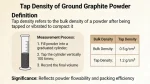
what is tap density of ground graphite powder

The tap density of ground graphite powder typically ranges from 0.10 g/cm³ to 1.30 g/cm³, with most common industrial values falling between 0.80 g/cm³ and 1.20 g/cm³ for battery-grade graphite materials. The exact value depends heavily on particle characteristics and processing methods. Typical Tap Density Ranges by Graphite Type Graphite Type Tap Density Range (g/cm³) Key Notes Expanded graphite (ground) 0.10-0.30 Lowest density due to porous, worm-like structure Flake graphite (milled) 0.60-0.90 Anisotropic shape limits packing efficiency Spherical graphite (ground…

The tap density of ground graphite powder typically ranges from 0.10 g/cm³ to 1.30 g/cm³, with most common industrial values falling between 0.80 g/cm³ and 1.20 g/cm³ for battery-grade graphite materials. The exact value depends heavily on particle characteristics and processing methods.

Typical Tap Density Ranges by Graphite Type

Graphite Type Tap Density Range (g/cm³) Key Notes
Expanded graphite (ground) 0.10-0.30 Lowest density due to porous, worm-like structure
Flake graphite (milled) 0.60-0.90 Anisotropic shape limits packing efficiency
Spherical graphite (ground + shaped) 0.90-1.20 Highest packing density due to optimized round shape
Battery-grade graphite (premium) 1.00-1.30 Achieved through specialized shaping and grading
Coarse graphite crystals (+65 mesh) 0.965 Example value for larger particle size fractions

Key Factors Affecting Tap Density

  1. Particle Shape: Spherical particles pack 20-30% more efficiently than flake or irregular shapes. Spheroidization (shaping) of ground graphite dramatically improves tap density from ~0.7 to ~1.1 g/cm³.
  2. Particle Size Distribution: A narrow, optimized distribution (typically D50 = 10-20 μm) with appropriate mix of particle sizes allows small particles to fill gaps between larger ones, maximizing packing efficiency.
  3. Milling Process: Longer milling times can reduce particle size but may increase flake aspect ratio, potentially lowering tap density unless combined with shaping steps. Vibratory disc milling has been shown to produce more consistent tap density results.
  4. Purification & Surface Treatment: Higher purity (>99.9%) and surface coatings (like carbon) can enhance particle flowability and packing behavior.

Battery-Grade Graphite Specifics

For lithium-ion battery anode applications, tap density is a critical parameter affecting volumetric energy density:
  • Commercial natural graphite anodes: 0.90-1.10 g/cm³
  • High-performance spherical graphite: 1.05-1.20 g/cm³
  • Premium artificial graphite: 1.10-1.30 g/cm³

Standard Measurement Method

Tap density is determined by:
  1. Filling a graduated cylinder with a known mass of graphite powder
  2. Mechanically tapping the cylinder (typically 300-3000 times at 250-300 taps/min)
  3. Measuring the final volume after tapping until minimal volume change occurs
  4. Calculating density as mass divided by tapped volume (ρ = m/V)
Common standards: ASTM B527, ISO 3953, USP <616>

Optimization Strategies

To increase tap density of ground graphite powder:
  • Implement spheroidization after milling to reduce particle aspect ratio
  • Optimize particle size distribution to create a “dense packing” arrangement
  • Use classification to remove ultrafine particles that can disrupt packing
  • Consider surface modification to improve flow properties
Note: The theoretical true density of graphite is 2.20-2.27 g/cm³, which is significantly higher than any tap density values due to interparticle voids.
About Us:
With over 20 years of dedicated expertise in ultrafine grinding technology, we deliver high-performance machinery that matches the precision and reliability of leading German and Japanese brands—at only 1/3 of their cost.

Beyond Equipment, We Deliver Total Confidence:
We provide Free Material Testing to ensure precise equipment selection, followed by professional on-site installation and comprehensive training. Our 24/7 technical support team ensures your production line remains efficient and worry-free.

Schedule Material Trial & Get a Customized Solution from Us

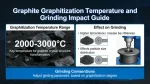
Graphitization is the high-temperature transformation of amorphous carbon into ordered graphite structure with hexagonal layers held by weak Van der Waals forces. The temperature requirements vary by application and material:…

15/03/2026

Expandable graphite (EG) is produced by inserting non-carbon atoms/molecules between flake graphite layers via grinding activation and chemical/electrochemical intercalation, creating graphite intercalation compounds (GICs) that expand dramatically when heated. Below…

14/03/2026

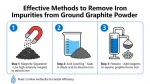
The most effective iron removal from ground graphite powder typically uses a multi-stage approach combining magnetic separation (for ferromagnetic particles) and chemical leaching (for oxidized and chemically bound iron), followed…

13/03/2026

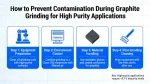
For high-purity graphite grinding (e.g., lithium-ion battery anode graphite with strict impurity requirements), contamination prevention needs a full-process control strategy covering equipment design/materials, grinding process, environmental management, material handling, and…

12/03/2026

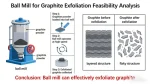
ball milling is a well-established and widely used method for the exfoliation of graphite to produce graphene (or few-layer graphene). It is considered one of the most promising techniques for the large-scale, cost-effective, and environmentally friendly production…

11/03/2026

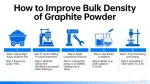
Bulk density = loose packing density (before tapping). Higher bulk density = better flow, less dust, less bridging, easier transportation. 1. Optimize Particle Size Distribution (Most Effective) Use wide particle…

09/03/2026

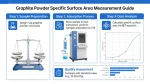
To measure the specific surface area (SSA) of graphite powder for quality assessment, the BET (Brunauer-Emmett-Teller) gas adsorption method is the industry standard (ISO 9277:2022, ASTM D8325-20) ASTM. It provides…

08/03/2026

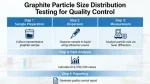
Quality control for graphite particle size requires representative sampling, proper dispersion to avoid agglomeration, and method matching to particle size range (sieving for >38 μm, laser diffraction for 0.1–1000 μm,…

07/03/2026

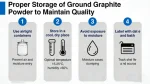
To maintain the quality of ground graphite powder, focus on controlling moisture, preventing oxidation, avoiding contamination, and managing physical degradation (agglomeration, particle size changes). Below is a structured approach to…

06/03/2026

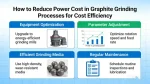
To reduce power costs in graphite grinding for cost efficiency, focus on equipment upgrades (20-60% savings), process optimization (15-30% savings), media selection (10-44% savings), automation (10-20% savings), and energy management…

05/03/2026