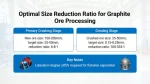
The best size reduction ratio for graphite ore processing depends on the stage of comminution and the type of graphite (flake vs. microcrystalline), with a critical focus on protecting flake structure while achieving sufficient mineral liberation. Below is a comprehensive breakdown of recommended ratios by processing stage:
1. Primary Crushing (Jaw/Gyratory Crusher)
- Reduction Ratio: 6:1 to 8:1 (maximum up to 10:1)
- Feed Size: ROM ore up to 1.5 m
- Product Size: 20-30 mm (for flake graphite)
- Key Consideration: Minimize impact force to avoid initial flake damage; compression-based crushing is preferred
2. Secondary Crushing (Cone Crusher)
- Reduction Ratio: 3:1 to 5:1
- Feed Size: 20-30 mm (from primary crushing)
- Product Size: 5-10 mm
- Key Consideration: Use closed-circuit crushing with screening to ensure uniform particle size for subsequent grinding
3. Tertiary/Ultrafine Crushing (High-Pressure Roll Mill – Preferred for Flake Graphite)
- Reduction Ratio: 4:1 to 6:1
- Feed Size: 5-10 mm (from secondary crushing)
- Product Size: 1-2 mm
- Key Advantage: Utilizes intergranular fracture to break along graphite-gangue interfaces rather than through graphite flakes, preserving flake size by 20%+ compared to traditional crushing
4. Coarse Grinding (Rod Mill – Critical for Flake Protection)
- Reduction Ratio: 8:1 (typical), range of 2:1 to 200:1 depending on configuration
- Feed Size: 1-2 mm (from tertiary crushing)
- Product Size: -150 μm (47-55% passing)
- Key Consideration: Line-to-line impact action minimizes flake breakage; ideal for initial liberation without excessive size reduction
5. Secondary Grinding (Ball Mill – for Further Liberation)
- Reduction Ratio: 10:1 to 20:1
- Feed Size: -150 μm (from rod mill)
- Product Size: -74 μm (65-70% passing)
- Key Consideration: Use stage grinding with classification to avoid overgrinding; for flake graphite, consider pebble mills instead of traditional ball mills
6. Tertiary/Regrinding (Stirred Mill – for High-Grade Applications)
- Reduction Ratio: 20:1 to 40:1 (for final liberation)
- Feed Size: -74 μm (from secondary grinding)
- Product Size: -45 μm (80-90% passing) for flake graphite; -10 μm for microcrystalline graphite
- Key Consideration: Use low-intensity grinding with long residence time to achieve liberation while minimizing flake damage
Critical Guidelines for Flake Graphite (Highest Value)
- Progressive Reduction Principle: Avoid large single-stage reduction ratios (>10:1) after primary crushing to prevent flake destruction
- Optimal Overall Comminution Ratio: 100:1 to 200:1 (from ROM to final product), distributed across 4-5 stages
- Liberation-Flake Balance:
- For flake graphite: Target 85-90% liberation at -150 μm to preserve +150 μm flakes (premium value)
- For microcrystalline graphite: Higher reduction ratios (up to 300:1) are acceptable as flake structure is absent
Why These Ratios Work for Graphite
| Factor | Impact on Graphite Processing |
|---|---|
| Flake Protection | Lower reduction ratios per stage reduce flake breakage, maintaining higher market value |
| Energy Efficiency | Progressive reduction minimizes overgrinding and energy waste (comminution uses 50-60% of total processing energy) |
| Liberation Control | Balances mineral exposure with particle size, optimizing flotation recovery |
| Product Quality | Preserves anisotropic properties critical for battery, lubricant, and refractory applications |
Final Recommendation
For flake graphite (most valuable), use a multi-stage comminution circuit with:
- Primary crushing: 6:1 to 8:1
- Secondary crushing: 3:1 to 5:1
- Tertiary crushing (HPGR): 4:1 to 6:1
- Rod mill grinding: 8:1
- Ball mill regrinding: 10:1 to 20:1
For microcrystalline graphite, higher overall reduction ratios (up to 300:1) can be used with more aggressive grinding, as flake preservation is not a concern.
Always conduct geometallurgical testing to determine the exact optimal ratios for your specific ore deposit, as graphite liberation characteristics vary significantly between different geological formations.