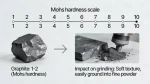
Graphite has a Mohs hardness of 1 to 2, making it one of the softest known minerals. This low hardness significantly influences its behavior during grinding and machining processes.
Impact of Low Hardness on Grinding:
-
Easy to Grind:
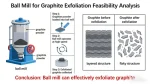
Due to its softness, graphite is readily abraded or crushed with minimal mechanical force. This makes it energy-efficient to grind compared to harder materials like quartz (Mohs 7) or corundum (Mohs 9). -
Lubricating Properties:
Graphite’s layered crystal structure allows sheets to slide over one another easily, giving it natural lubricity. During grinding, this can reduce friction between particles and grinding media, potentially lowering wear on equipment—but also possibly reducing grinding efficiency if slippage occurs. -
Fines Generation:
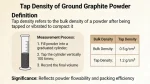
The softness leads to rapid formation of fine powders or dust, which can pose handling and health concerns (e.g., inhalation risks). Dust control measures (e.g., ventilation, wet grinding) are often necessary. -
Abrasive Wear on Equipment Is Low:
Unlike hard minerals that rapidly wear down grinding media (e.g., steel balls or ceramic liners), graphite causes minimal abrasive wear, extending equipment life. -
Contamination Sensitivity:
Because graphite is so soft, even small amounts of harder contaminants (e.g., silica or metal fragments) can dominate the wear behavior and damage processing equipment or degrade product purity—especially critical in applications like lithium-ion battery anodes. -
Agglomeration Tendency:
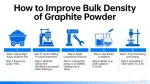
Fine graphite particles can stick together due to van der Waals forces, requiring additives or surface treatments to maintain dispersion during or after grinding.
Practical Applications:
- In refractories, batteries, and lubricants, graphite is often ground to specific particle sizes. Its softness allows precise size control but demands careful process design to avoid excessive fines or dust.
- In pencil manufacturing, the softness directly relates to the “lead” grade (e.g., HB, 2B)—softer graphite produces darker, smoother marks.
In summary, graphite’s low Mohs hardness (1–2) makes it easy and economical to grind, but requires attention to dust control, contamination, and particle agglomeration in industrial settings.