
Insights
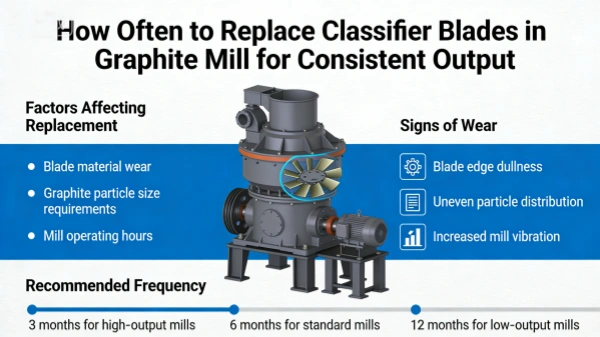
How Often to Replace Classifier Blades in Graphite Mill for Consistent Output
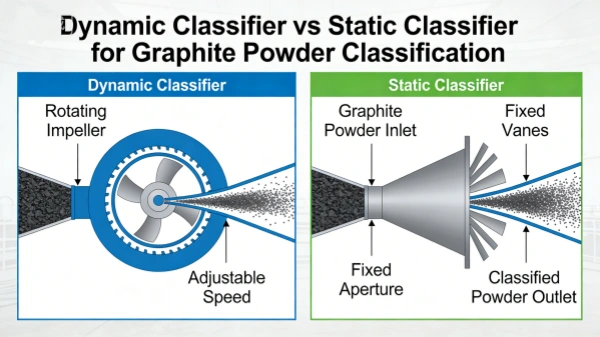
Dynamic Classifier vs Static Classifier for Graphite Powder Classification
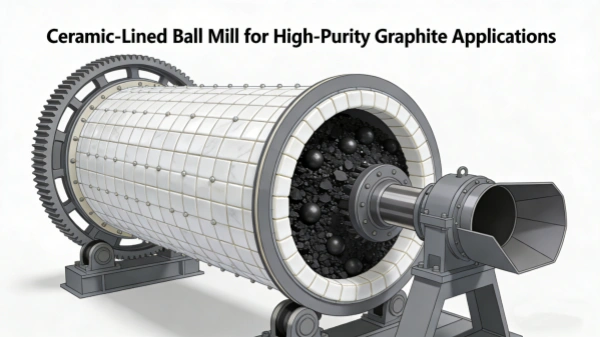
Ceramic-Lined Ball Mill for High-Purity Graphite Applications
To measure the specific surface area (SSA) of graphite powder for quality assessment, the BET (Brunauer-Emmett-Teller) gas adsorption method is the industry standard (ISO 9277:2022, ASTM D8325-20) ASTM. It provides…
08/03/2026
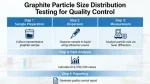
Quality control for graphite particle size requires representative sampling, proper dispersion to avoid agglomeration, and method matching to particle size range (sieving for >38 μm, laser diffraction for 0.1–1000 μm,…
07/03/2026
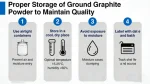
To maintain the quality of ground graphite powder, focus on controlling moisture, preventing oxidation, avoiding contamination, and managing physical degradation (agglomeration, particle size changes). Below is a structured approach to…
06/03/2026
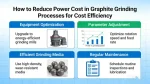
To reduce power costs in graphite grinding for cost efficiency, focus on equipment upgrades (20-60% savings), process optimization (15-30% savings), media selection (10-44% savings), automation (10-20% savings), and energy management…
05/03/2026
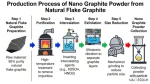
To produce nano graphite powder from natural flake graphite, the core process is top-down exfoliation/reduction from micron-scale flakes to <100 nm particles/sheets, typically via physical, chemical, or combined routes. Below…
04/03/2026
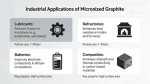
Micronized graphite (typically1-100 μm particle size, withd50 commonly 2-18 μm) is a versatile industrial material valued for its unique properties:self-lubrication,electrical/thermal conductivity,chemical stability,high-temperature resistance(up to 3200°C), andlithium intercalation capability. Below is…
03/03/2026
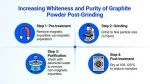
Increasing thewhiteness(brightness) andpurity(fixed carbon content) of graphite powder after grinding is a critical challenge, especially for high-value applications like lithium-ion battery anodes, conductive coatings, and refractories. Since mechanical grinding alone…
02/03/2026
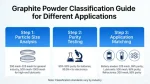
Graphite powder classification after grinding is a critical process to ensure optimal performance in diverse industrial applications. The classification process separates ground graphite particles based on multiple criteria to create…
01/03/2026
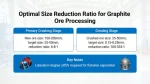
The best size reduction ratio for graphite ore processing depends on the stage of comminution and the type of graphite (flake vs. microcrystalline), with a critical focus on protecting flake…
28/02/2026
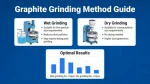
The optimal grinding method for graphite—wet grinding or dry grinding—depends on your target particle size, application requirements, and processing priorities (e.g., flake preservation, purity, energy efficiency, dust control). Below is…
27/02/2026
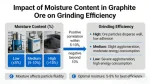
Moisture content is a critical process parameter for graphite grinding, with a non-linear impact on throughput, energy consumption, product quality (especially flake integrity for battery anodes), and equipment reliability. For…
26/02/2026
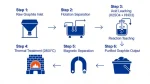
To achieve 99.95%+ purity for high-end applications (batteries, electronics, nuclear), graphite purification must be performed before grinding to avoid contaminating clean surfaces and to optimize energy efficiency. The process typically…
25/02/2026
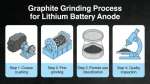
To grind graphite for lithium battery anodes effectively, follow a multi-stage process with precise particle size control, shape optimization, and strict quality standards. The goal is to produce spherical graphite…
30/01/2026
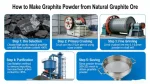
Making graphite powder from natural graphite ore involves a systematic process of extraction, beneficiation, grinding, purification, and classification. The exact steps vary slightly depending on the graphite ore type (flake,…
30/01/2026
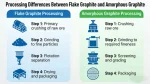
The core difference in processing flake graphite vs amorphous graphite (also called cryptocrystalline or microcrystalline graphite) stems from their distinct mineral structures: flake graphite has visible, larger, layered crystals with…
30/01/2026
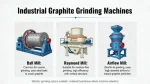
Industrial graphite grinding requires specialized equipment tailored to its unique properties (softness, lubricity, flake structure, and conductivity) and diverse applications (batteries, refractories, lubricants, etc.). Below is a comprehensive overview of…
30/01/2026
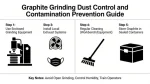
Here’s a practical, step-by-step guide to control dust and avoid contamination during small‑scale graphite grinding, focused on safety and purity. 1. Dust Control (the most critical part) Fully closed grinding…
30/01/2026
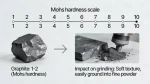
Graphite has a Mohs hardness of 1 to 2, making it one of the softest known minerals. This low hardness significantly influences its behavior during grinding and machining processes. Impact of Low…
30/01/2026
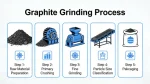
Graphite grinding is a multi-stage process designed to reduce graphite ore or blocks into fine powder while preserving its unique properties, particularly its flake structure (for natural graphite). The process…