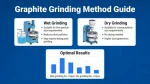
The optimal grinding method for graphite—wet grinding or dry grinding—depends on your target particle size, application requirements, and processing priorities (e.g., flake preservation, purity, energy efficiency, dust control). Below is a structured comparison and decision guide.
Quick Selection Guide
| Requirement | Preferred Method | Key Reason |
|---|---|---|
| Ultrafine particles (<20 μm, submicron, or nanoscale) | Wet Grinding | Prevents agglomeration; enables finer, more uniform particle size distribution |
| Flake graphite preservation (large flakes >0.15 mm) | Dry Grinding | Minimizes flake damage/fracture vs. wet processes |
| Dry final product (no drying step) | Dry Grinding | Eliminates liquid handling and energy-intensive drying |
| Heat-sensitive applications | Wet Grinding | Liquid medium dissipates heat, avoiding thermal degradation/amorphization |
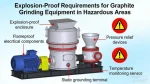
| Dust control & safety | Wet Grinding | Suppresses explosive graphite dust; improves workplace safety |
| Purity-sensitive (no liquid interaction) | Dry Grinding | Avoids potential contamination from water/solvents and capillary absorption |
| Energy efficiency | Wet Grinding | Uses up to 30% less power vs. dry grinding for equivalent fineness |
Detailed Comparison
Wet Grinding Advantages
- Superior particle size control: Produces finer, more uniform particles (<20 μm) with minimal agglomeration due to liquid dispersion
- Enhanced energy efficiency: Lower power consumption vs. dry grinding
- Thermal protection: Liquid medium prevents overheating, preserving graphite’s crystalline structure (critical for battery applications)
- Dust elimination: Eliminates health and explosion hazards from graphite dust
- Better for composite preparation: Ideal for creating stable slurries for electrodes or coatings
Wet Grinding Disadvantages
- Requires drying: Adds energy cost and processing time to obtain dry powder
- Potential contamination: Risk of liquid-induced pore penetration or solvent residues (avoid for purity-critical uses)
- Corrosion concerns: Higher equipment maintenance due to liquid exposure
Dry Grinding Advantages
- Flake preservation: Better maintains large flake structure (critical for high-value applications)
- Process simplicity: No liquid handling, mixing, or drying steps
- Purity assurance: Avoids water/solvent contamination risks
- Lower capital cost: Simpler equipment setup vs. wet grinding systems
Dry Grinding Disadvantages
- Agglomeration issues: Difficult to achieve particles <10 μm without agglomeration
- Heat generation: Risk of thermal degradation/amorphization in high-energy processes
- Dust challenges: Requires robust collection systems; safety hazards with fine graphite dust
- Lower efficiency: Higher energy consumption vs. wet grinding for equivalent fineness
Application-Specific Recommendations
-
Lithium-ion battery anodes
- Spherical graphite production: Dry grinding (classifier mills/fluidized bed jet mills) preserves structure for spheroidization
- Si@graphite composites: Wet grinding preferred for uniform dispersion and avoiding amorphization
- Ultrafine graphite: Wet grinding (bead mills) for particles <10 μm with controlled size distribution
-
Flake graphite beneficiation
- Coarse grinding: Dry rod mills or high-pressure roller mills to protect large flakes
- Fine grinding: Wet grinding if ultrafine particles are needed, with careful flake protection measures
-
Graphite electrodes for EDM
- Dry machining: Preferred to avoid coolant absorption and maintain electrode integrity
- Wet milling: Acceptable if followed by thorough drying (300–400°F/150–200°C)
-
Lubricants & conductive additives
- Wet grinding: Better for submicron particles with consistent size distribution, preventing agglomeration in final products
Final Verdict
There is no universal “best” method—match the grinding process to your specific goals:
- Choose wet grinding for ultrafine particles, heat-sensitive applications, or dust-sensitive environments.
- Choose dry grinding for flake preservation, dry final products, or purity-critical uses.
For many industrial operations, a hybrid approach (dry coarse grinding + wet fine grinding) optimizes both flake retention and fine particle production while balancing energy and processing costs.