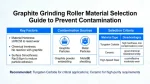
To prevent contamination in graphite grinding, prioritize non-metallic/chemically inert materials with ultra-low wear rates and minimal chemical interaction with graphite. Battery-grade graphite (iron <10 ppm) demands the strictest controls; industrial grades allow slightly more flexibility. Below is a structured selection guide.
Key Contamination Sources in Graphite Grinding
| Source | Contaminant | Impact |
|---|---|---|
| Roller wear | Metal (Fe, Ni, Cr), ceramic particles, binder elements | Degrades battery performance, affects conductivity, reduces purity |
| Chemical reaction | Ions from roller material leaching into graphite | Alters surface chemistry, interferes with Li-ion intercalation |
| Mechanical adhesion | Roller material fragments bonding to graphite surfaces | Creates hard spots, reduces flowability, increases impurity counts |
| Lubricant transfer | Oil/grease from bearings contaminating product | Ruins battery electrolyte compatibility, creates safety hazards |
Critical Selection Criteria
- Chemical Inertness: Must not react with graphite or form compounds at grinding temperatures (typically <200°C)
- Wear Resistance: Ultra-low wear rate to minimize particle shedding (target: <1 mg/kg of processed graphite)
- Hardness: Higher than graphite (Mohs 1-2) to prevent roller surface damage; ideal range Mohs 8-10
- Thermal Stability: Resist thermal shock from friction-induced temperature fluctuations
- Non-Adhesion: Surface should not bond with graphite particles (low surface energy)
- Purity: Base material must have impurity levels <10 ppm for battery applications
- Mechanical Strength: Withstand grinding pressures (50-500 bar in vertical roller mills) without cracking
Material Comparison for Grinding Rollers (Best to Least for Contamination Prevention)
1. Advanced Ceramic Materials (Top Choice for Battery-Grade)
| Material | Key Properties | Contamination Risk | Best Applications |
|---|---|---|---|
| Yttria-Stabilized Zirconia (Y-TZP) | • Hardness: 12 GPa Vickers• Density: 6.0 g/cm³• Wear rate: 2-5× lower than steel• Chemically inert | Extremely low (negligible ion release)ZrO₂ particles (if any) are non-toxic | Ultra-fine grinding for spherical graphite, battery anode materials |
| High-Purity Alumina (≥99.8% Al₂O₃) | • Hardness: 15 GPa Vickers• Cost-effective• Good thermal stability | Very low (minimal Al³⁺ leaching)Al₂O₃ particles easily removed by classification | General graphite processing, micronization (d50 5-20 μm) |
| Silicon Nitride (Si₃N₄) | • Low friction (0.02-0.1)• Exceptional fracture toughness• Thermal shock resistance | Ultra-low (no ionic contamination)Si₃N₄ is chemically compatible with carbon | High-pressure grinding, dry processing, precision applications |
2. Composite Materials (Balanced Performance)
- Ceramic-Embedded High-Chromium Iron: Ceramic particles (zirconia/alumina) in a metal matrix. Reduces metal contamination by 70-90% vs. plain steel but still carries metallic risk
- Carbon-Ceramic Composites: Graphite-reinforced ceramic matrix. Chemically identical to graphite, but lower wear resistance than pure ceramics
- Silicon Carbide (SiC) Composites: High hardness, good chemical stability, but risk of Si contamination (avoid for battery-grade)
3. Coated Metallic Rollers (Cost-Effective Alternative)
Use only when ceramic rollers are impractical. Prioritize these coatings:
- Diamond-Like Carbon (DLC): Ultra-low friction, high hardness, chemically inert. Reduces metal transfer by 95%+
- Titanium Nitride (TiN): Good wear resistance, but titanium contamination risk (limit to industrial grades)
- Zirconia Thermal Spray: Ceramic coating on steel. Better than uncoated steel but lower adhesion than monolithic ceramics
⚠️ Avoid: Uncoated steel, high-chrome steel, tungsten carbide (releases W/Co: 1963/482 ppm contamination)
Step-by-Step Selection Process
- Define Purity Requirements
- Battery-grade: Fe <10 ppm, total metals <20 ppm → 100% ceramic rollers (zirconia/silicon nitride)
- Industrial-grade: Fe <100 ppm → Ceramic or DLC-coated rollers
- Refractory-grade: Fe <500 ppm → Composite rollers acceptable
- Evaluate Grinding Conditions
- Pressure: High pressure (≥200 bar) → Prioritize silicon nitride (best fracture toughness)
- Temperature: >150°C → Choose zirconia (better thermal stability)
- Grinding type: Dry → Silicon nitride (low friction); Wet → Zirconia (corrosion resistance)
- Feed size: Coarse (≥1 mm) → Composite rollers; Fine (≤100 μm) → Monolithic ceramics
- Material Testing Protocol
- Request material certificates (impurity analysis, wear rate data)
- Conduct small-batch grinding trials (1-5 kg graphite)
- Analyze graphite post-grinding for:
- Metal content (ICP-MS for Fe, Ni, Cr, Zr, Al)
- Particle size distribution (D50, D90)
- Morphology (check for roller material adhesion)
- Compare wear rates (weight loss per hour of operation)
- Total Cost of Ownership Analysis
Factor Ceramic Rollers Coated Steel Composite Initial cost High (2-5× steel) Medium (1.5-3× steel) Medium-High Service life 5-10× steel 2-3× steel 3-5× steel Contamination cost Near-zero Low Moderate Maintenance Low Medium (recoat every 3-6 months) Medium For battery-grade graphite, ceramic rollers often provide lower total cost despite higher upfront investment
Best Practices for Contamination Prevention
- Full System Compatibility
- Match roller material with mill liners, classifier components, and feed chutes (all non-metallic for battery-grade)
- Use ceramic or PTFE seals to prevent lubricant contamination
- Operational Controls
- Maintain optimum grinding pressure (avoid overloading to reduce wear)
- Implement online particle monitoring (metal detector, laser particle analyzer)
- Schedule regular roller inspections (check for cracks, wear, coating delamination)
- Post-Grinding Purification
- Add magnetic separation (removes ferromagnetic contaminants)
- Use air classification (separates lighter graphite from denser roller wear particles)
- Consider acid washing (for battery-grade: removes ionic contaminants)
Final Recommendations by Application
| Graphite Type | Recommended Roller Material | Contamination Control Level |
|---|---|---|
| Lithium-ion battery anode | Yttria-stabilized zirconia or silicon nitride | Fe <5 ppm, total metals <15 ppm |
| EV battery cathode additive | High-purity alumina or silicon nitride | Fe <8 ppm, no leachable ions |
| Industrial lubricants | DLC-coated steel or composite ceramic | Fe <50 ppm, minimal particle contamination |
| Refractory materials | Composite ceramic-iron or TiN-coated steel | Fe <300 ppm, cost-priority selection |
By following this guide, you’ll minimize contamination while maintaining grinding efficiency. Always validate material performance with pilot-scale testing before full production implementation.