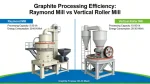
For graphite processing, the choice between Raymond mill and vertical roller mill (VRM) depends on your specific needs for capacity, fineness, energy efficiency, and operational continuity. Below is a detailed comparison focused on processing efficiency for graphite powder production.
⚙️ Working Principles: Core Differences
| Raymond Mill |
Vertical Roller Mill |
| Material is crushed between rotating rollers and a fixed ring – Centrifugal force throws material into classifier – Oversized particles fall back for regrinding |
Material forms a bed on rotating disc – Rollers press and shear the bed – Hot gas simultaneously dries and carries particles to classifier |
| Batch-like circulation |
Truly continuous closed-loop operation |
📊 Key Performance Metrics for Graphite Processing
1. Capacity & Scale Efficiency
| Parameter |
Raymond Mill |
Vertical Roller Mill |
Advantage |
| Typical Capacity |
1-35 t/h (max ~35 t/h) |
5-700 t/h (single unit) |
VRM: 10x higher maximum capacity for large-scale production |
| Scale Effect |
Diminishing returns at high capacities |
Maintains efficiency even at large scales |
VRM: Better suited for modern industrial graphite plants |
| Feed Size |
<30-35 mm |
<20 mm (requires finer pre-crushing) |
Raymond: Less demanding on upstream crushing |
2. Energy Consumption (Critical for Graphite Cost)
| Metric |
Raymond Mill |
Vertical Roller Mill |
Advantage |
| Unit Power Consumption |
20-50% higher than VRM |
30-50% lower than ball mill; 20-50% lower than Raymond |
VRM: Significant energy savings (up to 50%) for same output |
| Specific Energy (kWh/t) |
~40-60 kWh/t for 200 mesh graphite |
~25-40 kWh/t for same fineness |
VRM: Lower operational costs for long-term production |
3. Fineness Control & Product Quality
| Feature |
Raymond Mill |
Vertical Roller Mill |
Advantage |
| Fineness Range |
80-500 mesh (180-30 μm) |
60-2500 mesh (210-5 μm) |
VRM: Wider range (especially for ultrafine graphite) |
| Particle Size Distribution |
Broader, less uniform |
Sharper cut, more consistent PSD |
VRM: Better for battery-grade graphite requiring tight PSD control |
| Graphite Flake Protection |
Moderate (high shear may break flakes) |
Superior (lower shear, pressure-dominated) |
VRM: Better preserves valuable large flakes in Flake graphite processing |
4. Moisture Handling & Drying Capacity
| Capability |
Raymond Mill |
Vertical Roller Mill |
Advantage |
| Max Moisture Tolerance |
<6% (needs pre-drying) |
Up to 15% (integrated drying) |
VRM: Eliminates pre-drying step for high-moisture graphite concentrates |
| Drying Efficiency |
Limited (relies on external heating) |
High (direct hot gas injection) |
VRM: One-step drying + grinding reduces equipment footprint |
🛠️ Operational & Maintenance Considerations
1. Automation & Reliability
| Aspect |
Raymond Mill |
Vertical Roller Mill |
Advantage |
| Automation Level |
Basic to moderate |
Advanced (full PLC control) |
VRM: Higher automation enables 24/7 unmanned operation |
| Start-up |
Requires pre-loading material |
Light load start (no pre-distribution needed) |
VRM: Faster, more reliable start-up |
| Availability |
85-90% |
90-95% (fewer mechanical failures) |
VRM: Higher uptime for continuous graphite production |
2. Maintenance & Lifespan
| Factor |
Raymond Mill |
Vertical Roller Mill |
Advantage |
| Initial Cost |
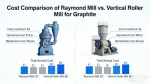
30-40% lower than VRM |
Higher upfront investment |
Raymond: Better for small-scale or budget-limited operations |
| Maintenance Cost |
Higher (more wearable parts) |
Lower (rollers have longer lifespan) |
VRM: Lower long-term maintenance expenses |
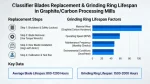
| Wear Parts |
Rollers, rings, and blades wear faster |
Rollers last 2-3x longer (no direct metal-to-metal contact) |
VRM: Reduced replacement frequency and downtime |
3. Environmental Performance
| Feature |
Raymond Mill |
Vertical Roller Mill |
Advantage |
| Dust Emissions |
Moderate (closed circuit but more leaks) |
Low (fully enclosed system) |
VRM: Better for environmental compliance |
| Noise Level |
Higher (metal-to-metal contact) |
Lower (material bed absorbs noise) |
VRM: Improved workplace conditions |
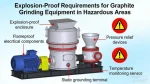
| Explosion Risk |
Higher (graphite dust accumulation) |
Lower (integrated inert gas system option) |
VRM: Safer for flammable graphite processing |
🎯 Application Suitability for Graphite Types
Raymond Mill Best For:
- Small to medium-scale graphite production (1-20 t/h)
- Lower budget projects
- Processing dry graphite (moisture <6%)
- 80-325 mesh (180-45 μm) graphite for general industrial applications
- Limited space or infrastructure constraints
Vertical Roller Mill Best For:
- Large-scale graphite production (20+ t/h)
- Battery-grade graphite requiring tight PSD control (D50 10-20 μm) processing (better flake preservation)
- High-moisture graphite concentrates (up to 15% moisture)
- Long-term continuous operation (24/7)
- Energy-efficient production to reduce carbon footprint
🏁 Decision-Making Guide for Graphite Producers
| Scenario |
Recommended Mill |
Key Reason |
| Battery Anode Graphite (high purity, tight PSD) |
Vertical Roller Mill |
Consistent fineness, lower energy, better flake protection |
| Small-scale Graphite Plant (1-10 t/h) |
Raymond Mill |
Lower capital cost, simpler operation |
| Large-scale Industrial Graphite (50+ t/h) |
Vertical Roller Mill |
Higher capacity, scale efficiency, lower unit cost |
| High-moisture Graphite Concentrates |
Vertical Roller Mill |
Integrated drying eliminates pre-treatment |
| Cost-sensitive Operations |
Vertical Roller Mill |
Lower energy consumption offsets higher initial cost within 1-2 years |
✅ Final Verdict on Processing Efficiency
For continuous, large-scale graphite powder production, Vertical Roller Mills deliver superior overall efficiency due to:
- Lower energy consumption (20-50% savings)
- Higher throughput (5-700 t/h vs 1-35 t/h)
- Better product quality (tighter PSD, preserved flakes)
- Integrated drying capability
- Higher automation enabling 24/7 operation
Raymond mills remain viable for small-scale operations or where initial investment is constrained, but for modern graphite processing (especially for lithium-ion battery applications), vertical roller mills are the industry standard for maximizing efficiency and product quality.