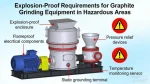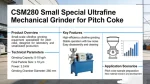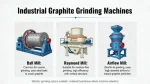
Industrial graphite grinding requires specialized equipment tailored to its unique properties (softness, lubricity, flake structure, and conductivity) and diverse applications (batteries, refractories, lubricants, etc.). Below is a comprehensive overview of the machines used for graphite grinding across industries.
🎯 Key Machine Categories for Graphite Grinding
| Machine Type | Working Principle | Typical Fineness Range | Best Applications | Advantages |
|---|---|---|---|---|
| Ball Mills | Rotating cylinder with grinding media (balls) causing impact/friction | 300–3000 μm | Flake graphite concentration, beneficiation | Low cost, simple operation, scalable |
| Rod Mills | Cylinders with steel rods for more gentle grinding | 500–5000 μm | Preserving large graphite flakes | Minimal flake damage, higher large-flake yield |
| Vertical Mills | Grinding rollers on rotating disc + integrated classifier | 38–1000 μm | Large-scale fine/ultra-fine grinding | Low energy use (30–40% less than ball mills), integrated drying, small footprint |
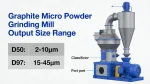
| Jet Mills | High-pressure air/steam accelerating particles for interparticle collision | 1–20 μm | Ultra-fine, high-purity graphite (battery anodes) | Contamination-free, narrow PSD, spheroidization capability |
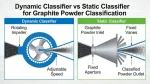
| Air Classifier Mills (ACM) | Mechanical grinding + built-in precision classifier | 5–45 μm | Battery materials, high-purity applications | Grinding + classification in one unit, precise PSD control |
| Raymond Mills (and upgrades) | Roller-ring system with centrifugal classification | 44–125 μm | General industrial graphite powder | Mature tech, cost-effective, easy maintenance |
| Stirred Mills | Rotating agitator moving media in a stationary cylinder | 1–100 μm | Fine grinding, high-purity processes | High energy efficiency, narrow PSD, low media wear |
| High-Pressure Micro-Powder Mills | Enhanced roller pressure for ultra-fine grinding | 3–45 μm | Specialty graphite applications | High fineness capability, good particle shape |
🔬 Detailed Machine Descriptions
1. Ball Mills (Traditional Workhorse)
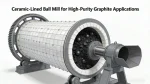
- Operation: Horizontal rotating cylinder with steel, ceramic, or zirconia balls; impact and attrition reduce particle size
- Variations:
- Wet Ball Mills: For beneficiation (flotation) processes, better particle separation
- Dry Ball Mills: For direct powder production, lower water consumption
- Grid Ball Mills: With discharge grids for coarser control, common in mineral processing
- Best for: Primary/secondary grinding in graphite beneficiation plants, pre-grinding for ultra-fine processing
2. Rod Mills (Flake Preservation Specialists)
- Operation: Similar to ball mills but using steel rods that grind along their full length, minimizing flake breakage
- Critical advantage: Preserves large graphite flakes (high value in many applications)
- Best for: Initial grinding stages where flake integrity is prioritized, before flotation separation
3. Vertical Mills (Modern Efficiency Leaders)
- Types:
- Ultrafine Vertical Mills: For 400+ mesh (38 μm+) graphite powder
- HLMX Series: Specifically designed for graphite with multi-head classifiers for 325–2500 mesh products
- Advantages:
- Integrated system: Drying, grinding, classification, and conveying in one unit
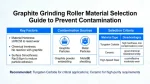
- Low metal contamination: Critical for high-purity applications like battery materials
- High production capacity: Suitable for large-scale industrial operations
4. Jet Mills (Ultra-Fine, High-Purity Experts)
- Key Variations:
- Fluidized Bed Opposed Jet Mill: 1–5 μm range, dynamic classification, ideal for spherical graphite/battery anodes, minimal contamination
- Spiral/Pancake Jet Mill: 5–20 μm, static classification, cost-effective for flake graphite
- Opposed Jet Mill with Classifier: 1–10 μm, precision control, handles heat-sensitive materials
- Why jet mills excel for graphite:
- No contact with mechanical grinding parts → zero contamination
- Produces spherical particles (critical for battery anode performance, improves tap density)
- Narrow particle size distribution (PSD) → consistent product quality
5. Air Classifier Mills (ACM) – All-in-One Solution
- Operation: Mechanical impact grinding (rotor-stator system) combined with a built-in precision classifier wheel for real-time particle size control
- Core benefits:
- Eliminates need for separate classification equipment
- Processes from coarse grinding to ultra-fine powder in one pass
- Adjustable fineness (325–2500 mesh) by changing classifier speed
- Best for: Graphite anode material production, where precise PSD and particle shape are essential
6. Specialty Graphite Grinding Equipment
- Mikron Graphite Series: High-speed milling machines dedicated to dry graphite machining with dust protection and precision control
- Spheroidizing Machines: For converting flake graphite to spherical graphite (battery applications), enhancing packing density and cycle life
- Impact Mills: High-speed mechanical mills for ultrafine grinding of carbon materials, ideal for green petroleum coke and natural graphite for lithium batteries
🧭 Selection Criteria for Graphite Grinding Machines
-
Fineness Requirements:
- Coarse grinding (80–200 mesh): Raymond mills, ball mills
- Fine grinding (325–400 mesh): Vertical mills, ACM
- Ultra-fine grinding (500–2500 mesh): Jet mills, stirred mills
-
Graphite Type:
- Flake graphite: Prioritize rod mills or jet mills to preserve flake structure
- Amorphous graphite: Ball mills or vertical mills for efficient size reduction
- Synthetic graphite: ACM or jet mills for consistent particle properties
-
Application-Specific Needs:
- Battery anodes: Jet mills or ACM for ultra-fine, spherical, contamination-free powder
- Refractories: Ball mills or vertical mills for cost-effective medium-fine grinding
- Lubricants: Jet mills for narrow PSD and controlled particle shape
- High-purity applications: Jet mills (no contamination) or ACM with ceramic components
-
Production Scale:
- Laboratory/small batch: Planetary ball mills, small jet mills
- Medium-scale: Raymond mills, ACM
- Large-scale: Vertical mills, fluidized bed jet mills, ball mill circuits
Graphite grinding machines range from traditional ball/rod mills to advanced jet mills and ACM systems, each optimized for specific particle sizes, purity levels, and applications. The fastest-growing segment—battery anode materials—demands ultra-fine (1–20 μm), spherical, contamination-free graphite, driving adoption of jet mills and specialized ACM technology. For flake graphite preservation, rod mills remain essential, while vertical mills provide the most energy-efficient solution for large-scale fine grinding operations.