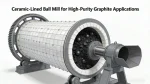
Ceramic-lined ball mills are critical equipment in high-purity graphite processing, designed specifically to maintain ultra-low contamination levels while achieving precise particle size reduction. These mills replace traditional steel liners and grinding media with advanced ceramic materials, making them ideal for graphite applications requiring 99.95%+ purity such as lithium-ion battery anodes, semiconductor components, and aerospace materials.
Why Ceramic Lining for High-Purity Graphite?
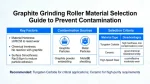
The primary driver for using ceramic-lined ball mills in graphite processing is contamination prevention:
| Challenge with Steel-Lined Mills | Ceramic Lined Solution |
|---|---|
| Iron (Fe), manganese (Mn), chromium (Cr) contamination from liner wear | Non-metallic ceramic barrier eliminates metal particle shedding |
| Chemical reactions with graphite at high temperatures | Chemically inert ceramics (Al₂O₃, ZrO₂) resist corrosion |
| Inconsistent particle size distribution | Uniform wear characteristics maintain stable grinding performance |
| Reduced graphite purity (down to 99.5%) | Preserves 99.95%+ purity required for advanced applications |
Key Ceramic Materials for Liners and Grinding Media
1. Alumina (Al₂O₃) Ceramics
- Purity grades: 92%, 95%, 99% (99% preferred for high-purity graphite)
- Hardness: Mohs 9 (second only to diamond)
- Wear resistance: 2000 hours continuous operation with only 0.8mm wear
- Cost-effectiveness: Best overall ROI for most industrial applications
- Ideal for: General high-purity graphite processing, battery materials
2. Zirconia (ZrO₂) Ceramics (Yttria-Stabilized)
- Superior toughness: Higher impact resistance than alumina
- Higher density: 6.0 g/cm³ vs. 3.9 g/cm³ (alumina), improves grinding efficiency
- Lower contamination: Ultra-pure grades available for semiconductor applications
- Ideal for: Lithium-ion battery anode graphite (D50 5-10 μm), ultra-fine grinding (D97 < 5 μm)
3. Silicon Nitride (Si₃N₄) Ceramics
- Exceptional thermal shock resistance: Maintains integrity at 1200°C+
- Self-lubricating properties: Reduces friction with graphite particles
- High strength: Resists cracking under heavy grinding loads
- Ideal for: High-temperature graphite processing, specialized aerospace applications
Equipment Design and Operational Features
Core Components
- Ceramic lining: Segmented bricks (rectangular, trapezoidal) with precision fit to prevent material leakage
- Grinding media: Ceramic balls (3-25 mm diameter) in mixed sizes (1:1:1:1 ratio by weight) for optimal impact forces
- Sealed chamber: Prevents cross-contamination from external environment
- Cooling jacket: Optional for temperature-sensitive graphite applications (prevents oxidation)
- Variable speed drive: Controls rotational speed for precise particle size adjustment
Operational Parameters for High-Purity Graphite
| Parameter | Typical Setting | Purpose |
|---|---|---|
| Rotational speed | 60-80% of critical speed | Balances impact and attrition forces |
| Ball charge ratio | 30-40% of mill volume | Maximizes grinding efficiency without excessive wear |
| Grinding time | 1-24 hours (batch) | Achieves D50 5-10 μm for battery anodes |
| Media-to-graphite ratio | 5:1 to 10:1 | Ensures sufficient grinding energy |
| Atmosphere | Inert gas (N₂, Ar) for ultra-high purity | Prevents graphite oxidation during processing |
Applications in High-Purity Graphite Processing
1. Lithium-Ion Battery Anode Material Production
- Particle size requirement: D50 5-10 μm with narrow PSD (polydispersity index < 0.5)
- Purity standard: 99.95%+ with Fe < 50 ppm, Cu < 10 ppm
- Ceramic choice: 99% alumina or yttria-stabilized zirconia for minimal contamination
2. Semiconductor and Electronic Applications
- Graphite components: Crucibles, heating elements, electrode materials
- Purity requirement: 99.99%+ with total metallic impurities < 10 ppm
- Ceramic choice: Ultra-pure zirconia or silicon nitride for highest purity preservation
3. Aerospace and Nuclear Graphite Components
- Applications: Rocket nozzles, nuclear reactor moderators
- Key requirement: Consistent particle size for uniform thermal conductivity
- Ceramic choice: Zirconia for high impact resistance during large-scale processing
4. Laboratory and Pilot-Scale Research
- Small-scale ceramic ball mills (25-50 L capacity) for process development
- Customizable liners: Quick-change ceramic segments for testing different materials
- Ideal for: Optimizing grinding parameters before full-scale production
Advantages of Ceramic-Lined Ball Mills for Graphite
- Contamination Control: Maintains < 10 ppm metallic impurities in final graphite product
- Cost Efficiency: Longer liner life (3+ years) reduces replacement frequency and downtime
- Energy Savings: Lower friction than steel liners reduces power consumption by 20-30%
- Process Consistency: Stable grinding performance ensures uniform particle size distribution batch after batch
- Material Versatility: Suitable for both wet and dry grinding of graphite and graphite composites
- Regulatory Compliance: Meets ISO 9001 and battery industry standards for purity control
Best Practices for Operation and Maintenance
- Pre-Processing:
- Ensure graphite feedstock is properly sized (1-5 mm) to avoid excessive liner wear
- Use ceramic-lined transfer equipment to prevent contamination before milling
- Media Management:
- Regularly inspect ceramic balls for cracks or excessive wear
- Replace worn media (typically 5-10% annually) to maintain grinding efficiency
- Use only ceramic media from the same manufacturer as liners to ensure compatibility
- Cleaning Protocol:
- After each batch, clean mill with high-purity water or alcohol (avoid metal brushes)
- Perform full ceramic liner inspection every 6 months to check for loose segments
- Contamination Testing:
- Conduct regular ICP-MS analysis of graphite powder for Fe, Mn, Cr, and other metallic impurities
- Maintain contamination records to ensure process consistency
Ceramic-lined ball mills are the gold standard for high-purity graphite processing, providing an unmatched combination of contamination control, grinding efficiency, and operational reliability. By selecting the appropriate ceramic material (99% alumina for general applications, zirconia for ultra-high purity), optimizing operational parameters, and implementing strict maintenance protocols, manufacturers can produce graphite with 99.95%+ purity required for lithium-ion batteries, semiconductors, and other advanced technologies.
For specific application requirements, consult with ceramic ball mill manufacturers to design a customized system that balances purity, efficiency, and cost-effectiveness.