Quick Reference:
| Component | Typical Replacement Interval | Key Wear Indicators |
|---|---|---|
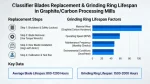
| Graphite Mill Classifier Blades | 4,000–8,000 operating hours (6–12 months) | Inconsistent particle size, increased energy consumption, visible wear >0.1mm |
| Carbon Processing VRM Grinding Rings | 6,000–12,000 operating hours (8–18 months) | Production decline, uneven wear patterns, excessive vibration |
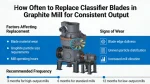
How Often to Replace Classifier Blades in Graphite Mills for Consistent Output
Classifier blades are critical for maintaining precise particle size distribution and stable product quality in graphite grinding operations .
1. Typical Replacement Intervals
| Operation Type | Interval | Rationale |
|---|---|---|
| Standard Graphite Processing | 4,000–6,000 hours (6–8 months) | Balances wear resistance with consistent classification |
| Ultrafine Graphite (Battery Anode Grade) | 3,000–5,000 hours (4–7 months) | Tighter tolerances demand more frequent replacement |
| Spherical Graphite Production | 5,000–8,000 hours (7–12 months) | Lower abrasivity than some other applications |
2. Key Factors Determining Replacement Frequency
| Factor | Impact on Wear Rate |
|---|---|
| Graphite Type | Natural graphite (more abrasive) > synthetic graphite |
| Fineness Requirement | Finer grind (D97 <10μm) accelerates wear 30–50% |
| Blade Material | Diamond-coated/ultra-fine carbide: 3–5× longer life than standard steel |
| Operating Conditions | Higher classifier speed, increased airflow = faster wear |
| Feed Purity | Contaminants (hard particles) drastically reduce lifespan |
3. Critical Replacement Indicators for Consistent Output
Replace blades immediately if you observe:
- Particle size inconsistency: D97 variation >10% from target, broader distribution
- Increased energy consumption: 15%+ rise without process changes
- Visible wear: Edge rounding, chipping, or wear exceeding 0.1mm
- Vibration or noise: Unusual operating sounds indicating imbalance
- Product contamination: Metal particles from worn blades in graphite powder
4. Maintenance Best Practices for Extended Blade Life
- Daily inspection: Check for visible damage, clearance changes, and contamination
- Weekly performance audit: Monitor particle size distribution and energy usage
- Preventive replacement: Schedule at 70–80% of expected lifespan to avoid quality issues
- Material upgrades: Use 500 Brinell quenched/tempered steel or chromium carbide blades for graphite applications
- Optimize operation: Maintain proper airflow/classifier speed balance to minimize unnecessary wear
Lifespan of Grinding Rings in Carbon Processing Vertical Roller Mills (VRMs)
Grinding rings (or table liners) are the heart of vertical roller mills, directly influencing grinding efficiency and product quality in carbon/graphite processing .
1. Typical Lifespan Expectations
| Carbon Material | Lifespan (Hours) | Lifespan (Months) |
|---|---|---|
| Graphite (Natural/Synthetic) | 8,000–12,000 | 10–18 |
| Carbon Electrodes | 6,000–9,000 | 8–12 |
| Carbon Black | 5,000–8,000 | 7–11 |
| Petroleum Coke | 4,000–6,000 | 6–9 (higher abrasivity) |
Note: These are for high-quality high-chromium cast iron or alloy steel grinding rings under normal operating conditions .
2. Factors Affecting Grinding Ring Wear Life
| Factor | Effect on Lifespan |
|---|---|
| Material Hardness | Graphite (Mohs 1–2) causes less wear than harder carbons |
| Feed Characteristics | Coarse feed ( >5mm) reduces life by 20–30% |
| Grinding Pressure | Higher pressure increases wear rate exponentially |
| Ring Material Quality | Ni-Hard Type IV > High-Chromium Cast Iron > Manganese Steel |
| Wear Protection | Laser cladding or carbide buttoning extends life by 30–50% |
3. Wear Mechanisms and Failure Modes
- Abrasive Wear: Primary mechanism in graphite processing—particles erode ring surface
- Fatigue Wear: Cyclic loading causes surface cracking (appears after 60–70% lifespan)
- Adhesive Wear: Occurs at high temperatures, forming material transfer layers
- Edge Chipping: Caused by hard contaminants or uneven loading
4. Replacement Triggers for VRM Grinding Rings
| Indicator | Action Required |
|---|---|
| Production capacity drop >15% despite parameter adjustments | Schedule replacement within 2 weeks |
| Uneven wear (difference >2mm across ring circumference) | Immediate replacement to prevent damage |
| Visible cracks or deep grooves ( >3mm depth) | Emergency replacement to avoid catastrophic failure |
| Excessive vibration (2× normal levels) | Inspect and replace if necessary |
Optimizing Component Lifespan for Consistent Output
For Classifier Blades:
- Material Selection: Use diamond coatings or ultra-fine grain carbide for graphite applications—3–5× longer life
- Operational Optimization: Run classifier at minimum effective speed while maintaining target fineness
- Preventive Maintenance: Rotate blades quarterly to ensure even wear (for reversible designs)
For Grinding Rings:
- Material Upgrades: Choose Ni-Hard Type IV or high-chromium cast iron (63–65 HRC)
- Process Control: Maintain stable material bed thickness to avoid metal-to-metal contact
- Wear Protection: Apply laser cladding with wear-resistant alloys to extend life by 30–50%
- Monitoring: Implement vibration analysis and wear sensors for predictive maintenance
For consistent output quality in graphite processing:
- Replace classifier blades every 4,000–8,000 hours (6–12 months), or sooner if quality parameters drift
- Expect grinding rings in carbon processing VRMs to last 6,000–12,000 hours (8–18 months), with proper maintenance
Always base replacement decisions on actual operating conditions, wear measurements, and product quality metrics rather than relying solely on calendar time or hours of operation.