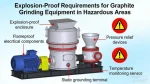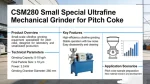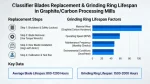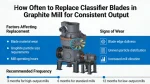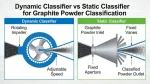
For graphite powder classification—especially critical for battery anode applications demanding narrow PSD (particle size distribution) and precise control—the core trade-off is precision and adjustability (dynamic) versus simplicity and low operational cost (static). Dynamic classifiers dominate high-end graphite processing, while static systems serve cost-sensitive or coarse-separation stages.
Working Principles
Static Classifier
- Passive separation relying on gravity, inertia, and fluid dynamics (no moving parts)
- Fine particles carried by airflow to collection; coarse particles settle or return to grinding
- Cut point controlled by fixed geometry and airflow rate; limited real-time adjustment
- Examples: gravity classifiers, hydrocyclones, simple air classifiers
Dynamic Classifier
- Active separation using motor-driven rotating elements (rotor cage, impeller, classifier wheel)
- Creates controlled vortex/centrifugal force to augment separation
- Fine particles pass through classifier wheel gaps; coarse particles thrown outward and recirculated
- Stepless adjustment of cut point via rotor speed (higher speed = finer product)
- Examples: turbine classifiers, air classifier mills with built-in precision wheels
Key Performance Comparison for Graphite Processing
| Parameter | Static Classifier | Dynamic Classifier | Graphite-Specific Implications |
|---|---|---|---|
| Classification Accuracy | Lower; wider PSD (D90/D10 ratio >2.5) | Higher; sharp cut, narrow PSD (D90/D10 ratio <1.8) | Battery anodes require D50=5-20μm with tight control—dynamic delivers |
| Adjustability | Limited to airflow changes; time-consuming | Instant rotor speed adjustment; real-time fineness control | Critical for graphite anode production line flexibility |
| Handling of Graphite Agglomeration | Poor; tends to pass agglomerates as “fines” | Excellent; shear from rotating elements breaks agglomerates | Graphite’s layered structure causes agglomeration—dynamic maintains true particle separation |
| Energy Consumption | Low (no motor); ~2-5 kWh/t | Higher (motor + airflow); ~8-15 kWh/t | Dynamic’s energy cost offset by reduced reprocessing and better yield |
| Maintenance | Minimal (no moving parts); annual inspection | Moderate (bearings, seals, wear parts); quarterly maintenance | Graphite’s lubricity reduces wear but demands proper sealing to prevent contamination |
| Purity Preservation | Good (no metal contact); risk of cross-contamination | Excellent (closed-loop design); requires material-compatible rotor coating | Battery-grade graphite needs 99.95%+ purity—dynamic’s closed system minimizes risk |
| Capacity Range | High (10-100 t/h); better for coarse separation | Medium (1-50 t/h); optimal for fine/ultra-fine classification | Dynamic preferred for final stage of graphite anode processing |
| Capital Cost | Low (simple design) | Higher (precision engineering) | Dynamic justifies cost for premium graphite products |
Graphite-Specific Performance Advantages
Dynamic Classifier Superiority for Battery-Grade Graphite
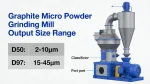
- Precise PSD Control: D97=5-45μm continuously adjustable—matches anode material requirements
- Anti-Overgrinding Protection: Real-time classification prevents damage to graphite’s layered crystal structure, preserving conductivity and capacity
- Agglomerate Disintegration: Rotor shear breaks weak interparticle bonds without damaging primary particles
- Consistent Quality: Stable classification regardless of feed variations—critical for battery performance consistency
- Closed-Loop Operation: Minimizes dust emissions and cross-contamination, essential for high-purity graphite
Static Classifier Advantages
- Low Initial Investment: Suitable for pilot plants or low-value graphite applications
- Simple Operation: Minimal training; ideal for remote or low-maintenance environments
- Low Energy Demand: Cost-effective for pre-classification before final dynamic separation
- No Heat Generation: Safe for temperature-sensitive graphite processing stages
Application Recommendations for Graphite Processing
| Graphite Application | Preferred Classifier | Rationale |
|---|---|---|
| Lithium-Ion Battery Anodes | Dynamic Classifier | Demands narrow PSD (D50=8-12μm), high sphericity, and purity >99.95% |
| Spherical Graphite Production | Dynamic Classifier | Enables precise control during shaping process to maintain roundness |
| Industrial Lubricants | Static (pre-class) + Dynamic (final) | Balances cost and quality for mid-grade applications |
| Foundry Additives | Static Classifier | Coarse separation (100-300μm) sufficient; cost-sensitive |
| Coating & Composite Fillers | Dynamic Classifier | Requires consistent particle size for uniform dispersion |
| Graphite Nanoparticle Production | Dynamic Classifier (specialized) | Ultra-fine separation (<5μm) with high recovery rate (96%+) |
Implementation Best Practices
- Hybrid Approach: Use static classifiers for pre-separation (removing large contaminants) followed by dynamic classifiers for final precision grading—optimizes cost and performance
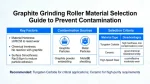
- Graphite-Specific Design: For dynamic classifiers, select tungsten carbide-coated rotors to minimize wear from abrasive graphite particles
- Process Integration: Pair with air classifier mills for simultaneous grinding and classification—reduces overgrinding and energy consumption
- Online Monitoring: Combine with laser particle size analyzers for real-time feedback to dynamic classifier control systems
- Sealing System: Critical for both types to prevent graphite dust leakage and maintain purity
For high-performance graphite applications—especially battery anodes—the dynamic classifier is the clear choice, delivering unmatched precision, adjustability, and quality control essential for modern energy storage materials. Static classifiers remain viable for cost-sensitive, coarse-separation stages or non-critical applications where strict PSD control is unnecessary.
The decision ultimately hinges on product value: premium graphite products justify dynamic classifier investment, while basic industrial grades can achieve acceptable results with static systems.