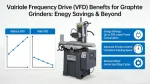
VFDs deliver substantial energy savings (typically 15-40%) for graphite grinders by matching motor speed to actual load demand, optimizing process efficiency, and reducing mechanical stress. The greatest savings occur when grinders operate under variable loads, such as during startup, material changes, or varying particle size requirements.
1. Core Energy-Saving Mechanisms
a) “On-Demand” Power Delivery
Traditional fixed-speed motors run at full RPM regardless of load, wasting energy through mechanical throttling or idling. VFDs:
- Adjust frequency/voltage to match graphite grinding requirements (e.g., 20% speed reduction = 50% energy savings via the cube law for variable torque loads)
- Eliminate “over-design” losses where motors are sized for peak demand but operate at partial load most of the time
- Maintain optimal efficiency (up to 97%) across 70-90% load range
b) Soft Start & Reduced Inrush Current
- Replace direct-on-line (DOL) starting with smooth acceleration, cutting inrush current from 600-800% of rated to 120-150%
- Eliminate energy spikes and mechanical shock loads that waste power and damage components
- Allow multiple grinders to operate on the same power grid without overloading transformers
c) Power Factor Correction
- Improve power factor from 0.6-0.8 (typical for unloaded induction motors) to 0.95-0.99
- Reduce reactive power charges from utilities and improve overall electrical system efficiency
2. Graphite Grinder-Specific Energy Savings
Load Characteristics & Savings Potential
| Grinder Type | Load Profile | Typical VFD Savings | Key Benefits |
|---|---|---|---|
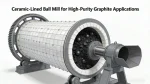
| Ball/Rod Mill | Variable torque (high startup, lower steady-state) | 12-25% | Reduced wear on liners/balls; optimized grinding media impact velocity |
| Vertical Roller Mill (VRM) | Semi-variable torque | 15-30% | Better control of grinding pressure; reduced fan energy use |
| Air Classifier Mill | Variable torque (classifier wheel + grinding rotor) | 20-40% | Prevents over-grinding; precise particle size control (D97 = 5-45μm) |
| Hammer Mill | Intermittent load | 18-35% | Adjust impact force for different graphite grades; reduce noise/vibration |
Case Study: Graphite Anode Material Processing
A lithium-ion battery plant retrofitted VFDs on air classifier mills for spherical graphite production:
- 28% energy reduction by eliminating over-grinding and optimizing classifier speed
- 15% increase in production capacity through consistent particle size distribution
- 22% lower maintenance costs due to reduced mechanical stress on grinding components
3. Additional Operational Benefits Enhancing Energy Efficiency
a) Process Optimization
- Fine-tune speed for different graphite types (natural vs. synthetic, flake vs. amorphous)
- Match rotational speed to feed rate and desired fineness (e.g., 5-25μm for battery anodes)
- Reduce energy waste from “blind grinding” where material is over-processed beyond specifications
b) Extended Equipment Life = Lower Energy Costs
- Soft starts reduce mechanical wear on gears, bearings, and grinding media by 30-50%
- Reduced vibration and thermal cycling extend motor insulation life by 2-3x
- Lower operating temperatures (5-10°C) improve motor efficiency and reduce cooling system energy use
c) Intelligent Control Features
- Auto-tuning: Adjust parameters for changing graphite moisture content or purity
- Load monitoring: Detect material blockages early, preventing energy-wasting overloads
- Multi-speed programs: Preset optimal speeds for different production stages (coarse grind → fine grind)
- Sleep mode: Reduce speed to minimum during idle periods, cutting energy use by 80%+
4. ROI & Implementation Considerations
Typical Payback Period
- 6-18 months for continuous-operation graphite processing plants (8,000+ hours/year)
- Faster ROI (3-6 months) with utility rebates for energy-efficient equipment upgrades
Implementation Best Practices
- Conduct energy audit to identify high-potential grinders (those with variable loads or frequent startups)
- Size VFD correctly (110-120% of motor rating) to handle transient loads during graphite grinding
- Integrate with process control systems (PLC/DCS) for automated speed adjustments based on feed rate/particle size sensors
- Consider regenerative braking for large grinders (>100kW) to recover energy during deceleration
5. Summary of Energy & Operational Benefits
| Benefit Category | Quantifiable Impact |
|---|---|
| Direct Energy Savings | 15-40% reduction in electricity consumption |
| Maintenance Cost Reduction | 20-35% lower repair/replacement expenses |
| Production Efficiency | 10-20% higher throughput via optimized grinding parameters |
| Carbon Footprint | 15-40% reduction in CO₂ emissions (equivalent to taking 5-10 cars off the road annually for a 1MW grinder) |
VFDs are a cost-effective investment for graphite grinding operations, delivering rapid ROI through energy savings and operational improvements. For lithium-ion battery anode production, where energy costs account for 30-40% of total processing expenses, VFD implementation is particularly impactful, enabling precise control of particle size distribution while reducing operational costs and environmental impact.
Recommendation: Prioritize VFD installation on the largest grinders with the most variable load profiles first, then expand to auxiliary systems (fans, pumps, conveyors) for comprehensive energy optimization.