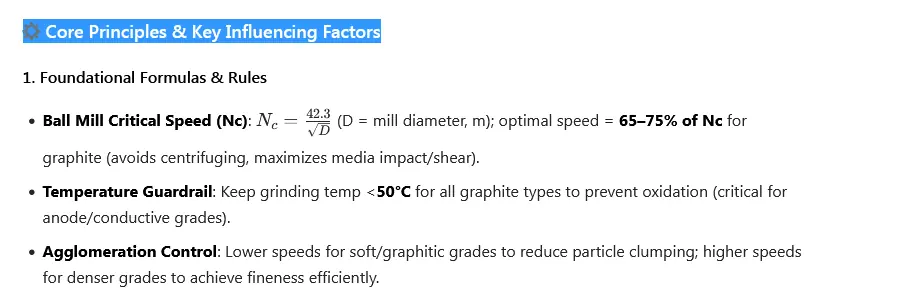
Optimal grinding speed for graphite hinges on graphite type, target particle size, equipment type, and application requirements —balancing efficiency, product quality (e.g., tap density, conductivity), and equipment protection (avoid overheating/oxidation). Below is a systematic, equipment-specific guide tailored to common graphite variants.
2. Critical Variables
Factor
Impact on Speed Selection
Graphite Type Hardness, crystallinity, lubricity, and expandability dictate speed (e.g., high-purity graphite needs precise low-speed control; expandable graphite requires slow, low-shear grinding).
Target Particle Size Finer grades (D50 < 10 μm) need higher speeds (but with cooling); coarser grades (D50 50–100 μm) use moderate speeds for energy efficiency.
Equipment Type Ball mills (batch/continuous), Raymond/vertical mills, jet mills , and vibrating disc mills have distinct speed ranges and optimal operating modes.
Application Anode materials (high tap density) need low-shear, controlled-speed grinding; lubricant/graphite powder uses higher speeds for ultra-fineness.
📊 Optimal Speed by Graphite Type & Equipment
Graphite Type
Key Characteristics
Best Equipment
Optimal Speed Range
Critical Parameters
Target Particle Size
Typical Application
Natural Flake Graphite High crystallinity, layered structure, lubricity; prone to agglomeration
Ball Mill (continuous)
60–70% of Nc (15–35 rpm for 1.5–3 m diameter mills)
Media size: 10–20 mm; ball-to-powder ratio: 5:1–8:1; temp < 45°C
D50 20–50 μm (coarse); D50 10–20 μm (fine)
Lubricants, refractories, battery anodes
Jet Mill Classifier wheel: 2,000–4,000 rpm; feed rate: 50–200 kg/h
Milling pressure: 0.6–0.8 MPa; dry grinding only
D50 5–15 μm
High-purity conductive powder
Artificial Graphite (Coke-Based) Denser, lower crystallinity; used for anodes; sensitive to overheating
Vertical Mill (LUM series)
Spindle speed: 800–1,500 rpm; classifier speed: 1,500–3,000 rpm
Feed size: <1 mm; temp < 50°C
D50 6–18 μm
Lithium-ion battery anodes
Ball Mill (spheroidizing stage)
55–65% of Nc (10–25 rpm)
Low media impact; high shear
D50 7–9 μm (spherical)
High-performance anodes
Expandable Graphite Intercalated structure; thermal expansion >200×; sensitive to shear/heat
Vibrating Disc Mill
Rotor speed: 400–800 rpm; grinding time: 60–120 s
Low amplitude vibration; dry grinding
D50 40–100 μm
Flexible graphite, gaskets
High-Purity Graphite (99.5%+ C) Low impurity, fine grain; brittle; needs precision
Jet Mill (ultra-fine)Classifier wheel: 3,000–5,000 rpm; feed rate: 20–80 kg/h
Milling pressure: 0.8–1.2 MPa; dust-free enclosure
D50 1–5 μm
Semiconductors, aerospace
Precision Ball Mill
50–60% of Nc (8–20 rpm)
Small media (5–10 mm); low vibration
D50 3–8 μm
High-purity electronic components
🔧 Equipment-Specific Speed Optimization
1. Ball Mills (Most Common for Graphite)
Baseline Setup : Start at 65% Nc; adjust by ±5% based on product quality.Natural Flake Graphite : Use 65–70% Nc to minimize agglomeration; add anti-agglomerant (e.g., stearic acid) for ultra-fine grades.Artificial Graphite : 60–65% Nc to avoid overheating; pair with cooling jackets to maintain <50°C.Key Checks : Monitor vibration (1× rotational frequency < 2.5 mm/s RMS) and motor current (≤85% of rated load) to avoid overload.
2. Raymond/Ultrafine Vertical Mills
Raymond Mill : Spindle speed = 80–160 rpm ; classifier speed = 1,200–2,500 rpm (coarse-to-medium grinding).LUM Vertical Mill : Spindle speed = 600–1,200 rpm; 3-stage classifier speed = 1,500–3,000 rpm (high-purity graphite).Rule : Increase classifier speed for finer particles; reduce spindle speed to lower energy use.
3. Jet Mills (Ultra-Fine Grinding)
Core Link : Classifier wheel speed directly controls particle size—higher speed = finer powder .Natural Flake Graphite : 2,000–4,000 rpm classifier speed; pressure 0.6–0.8 MPa.High-Purity Graphite : 3,000–5,000 rpm; pressure 0.8–1.2 MPa; use inert gas (N₂) to prevent oxidation.Critical : Keep feed rate stable to avoid speed fluctuations (use VFD for feed control).
4. Vibrating Disc Mills (Expandable Graphite)
Speed Range : 400–800 rpm; avoid >800 rpm to preserve expandability.Grinding Time : 60–120 s (no benefit beyond 120 s; reduces tap density).Vibration Control : Amplitude < 2 mm to prevent particle damage.
📈 Speed Calibration & Dynamic Adjustment Workflow
Step 1: Establish Baseline
Collect 3–5 days of stable operating data (no load changes, steady feed).
Record: speed, vibration (RMS), motor current, temp, and particle size (D50/D97).
Set warning/critical thresholds :
Vibration: Warning = 1.5× baseline; Critical = 2.5× baseline.
Current: Warning = 80% rated; Critical = 95% rated.
Temp: Warning = 45°C; Critical = 50°C.
Step 2: Iterative Optimization
Adjust speed by ±5–10% (small increments to avoid instability).Evaluate 3 key metrics after each adjustment:
Particle Size : D50/D97 vs. target; agglomeration rate (via laser diffraction).Product Quality : Tap density (graphite anodes: >0.8 g/cm³), conductivity, expansion ratio (expandable graphite).Efficiency : Specific energy consumption (kWh/t) and throughput.
Lock optimal speed when metrics meet targets; document for repeatability.
Step 3: Real-Time Monitoring
Install multi-sensor fusion (vibration accelerometers, temperature probes, current transformers) for continuous tracking.
Use AI/ML algorithms to auto-adjust speed for feed rate/material property changes (e.g., moisture, hardness).
🛠️ Daily Maintenance & Troubleshooting
1. Preventive Checks (Daily)
Check
Action
Speed Adjustment Trigger
Vibration Measure at bearing housings (3 directions: horizontal/vertical/axial)
Vibration > warning threshold → reduce speed by 5–10%
Motor Current Check load vs. rated
Current > 80% → lower speed; < 60% → increase speed (if particle size is off)
Temperature Monitor grinding zone temp
Temp > 45°C → reduce speed + activate cooling
Particle Size Quick sieve test (100/200 mesh)
Oversize > 5% → increase speed (jet mills : raise classifier speed)
2. Common Issues & Speed Fixes
Issue
Root Cause
Speed Adjustment
Complementary Fix
Excessive Agglomeration (natural graphite)Speed too high → shear-induced clumping
Reduce speed by 10–15%
Add anti-agglomerant; increase media roundness
Overheating (artificial graphite)Speed too high → friction heat
Reduce speed by 5–10% + cool jacket; lower feed rate
Poor Expandability (expandable graphite)Speed too high → shear damage
Lower to 400–600 rpm; reduce grinding time
Low Tap Density (anode graphite)Speed too low → poor particle packing
Increase speed by 5–8%; optimize ball-to-powder ratio
Equipment Vibration Speed near resonance
Shift speed by ±5% (avoid 1×/2× natural frequency)
Add damping pads; realign shafts
📋 Long-Term Maintenance Strategy
1. Scheduled Maintenance (Weekly/Monthly)
Calibrate Sensors : Verify vibration/current/temp sensors for accuracy (monthly).Lubricate Bearings : Use high-temp grease (200°C+) to reduce friction (critical for high-speed jet mills).Inspect Classifiers : Clean blades/rotors (weekly) to avoid imbalance → speed fluctuations.Align Shafts : Laser alignment (monthly) to prevent vibration-induced speed drift.
2. Annual Overhaul
Replace worn bearings, liners, and classifier wheels.
Recalibrate VFDs and speed control systems.
Update baseline data for new equipment conditions.
✅ Key Validation Metrics
After setting speed, confirm:
Particle Size : D50/D97 matches target (e.g., D50 7–9 μm for anode graphite).Product Quality : Tap density >0.8 g/cm³ (anodes); expansion ratio >200× (expandable graphite); conductivity >100 S/m (high-purity).Equipment Health : Vibration < 2.5 mm/s RMS; motor current < 85% rated; temp < 50°C.Efficiency : Specific energy consumption < 1.2 kWh/t (ball mills); throughput > 80% of design capacity.
📌 Quick Reference Cheat Sheet
Graphite Type
Equipment
Optimal Speed
Key Guardrail
Natural Flake
Ball Mill
65–70% Nc
Temp < 45°C
Artificial Graphite
Vertical Mill
Spindle 800–1,500 rpm
Classifier 1,500–3,000 rpm
Expandable Graphite
Vibrating Disc Mill
400–800 rpm
Grinding time ≤120 s
High-Purity Graphite
Jet Mill
Classifier 3,000–5,000 rpm
Pressure 0.8–1.2 MPa